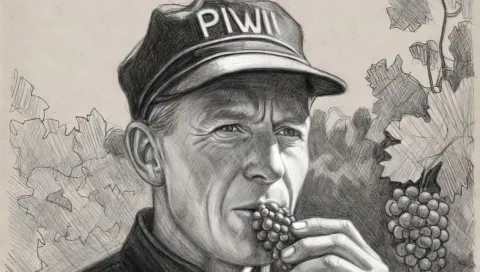
A childhood shaped by soil
Thomas Volney Munson was born on September 26, 1843, in Astoria, Illinois, the son of William and Maria Munson. From early childhood he showed an unusual preoccupation with plants, and that instinct never left him. He graduated from the University of Kentucky in Lexington in 1870, then stayed on as a professor of science for the following year. On June 27, 1871, he married Ellen Scott Bell and went into business with her father, Charles Stuart Bell, in the nursery trade. He once declared the grape the most beautiful, most wholesome and nutritious, most certain and profitable fruit that can be grown. That was not a poetic flourish. It was a statement of intent.
Nebraska, locusts, and a lesson in failure
In 1873, Munson moved his family to Lincoln, Nebraska, where he opened a small horticultural nursery and began systematic cross-pollination experiments with native grape species. The climate destroyed his ambitions. Droughts hit, hard winters followed, and in 1874 the Rocky Mountain locust swept through in one of the most catastrophic insect swarms in North American history. Munson recalled that the grasshoppers made life impossible for a nurseryman. The Nebraska years were not wasted, though. He noticed that northern Vitis labrusca and European Vitis vinifera varieties showed high susceptibility to disease, while native wild grapes largely resisted it. That observation became the foundation of his future work.
Denison, Texas: a permanent address
In April 1876, Munson moved to Denison, Texas, where two of his brothers, William Benjamin and J.T. Munson, were already established in insurance and real estate. He involved himself in those businesses too, but Texas changed him. The botanical diversity of North Texas and the surrounding region was unlike anything he had encountered. He began collection trips that eventually covered more than 50,000 miles by rail, and hundreds more on horseback and on foot, across Texas, forty other states, and Mexico. He later wrote that these journeys rekindled his passion for experimental work with grapes. His nursery in Denison, initially called the Denison Nursery and later known as the Munson Nursery, grew into one of the largest in the American South. It shipped fruit trees, grape cultivars, and horticultural equipment, including a patented diamond scuffler hoe, to customers across the country. His home, a two-story brick Italianate structure he named Vinita, was built in 1887 at the corner of Hanna Street and Mirick Avenue in Denison. Designated a Texas Historic Landmark in 1967, it has since been restored and is open for tours.
Mapping American grapes
By 1885, Munson had assembled an extensive herbarium of many American grape species, which he exhibited in New Orleans for the American Horticultural Society of the time. That same year he presented a paper on the classification of American grape species to the Mississippi Valley Horticultural Society, which brought him international attention. He published his findings widely, including in the American Agriculturalist, Farm and Ranch, and the French journal Revue de Viticulture. In 1883 he earned a master of science degree from the Agricultural and Mechanical College of Kentucky for a thesis on the forests and forest trees of Texas, which later appeared in the American Journal of Forestry. In the 1880s, working with William Henry Prestele, the first artist on staff at the USDA's Pomological Division, Munson began developing a lavishly illustrated monograph titled The Native Grapes of North America. Prestele produced life-size watercolor paintings from dried and live specimens Munson shipped to Washington. The U.S. Secretary of Agriculture ultimately decided the printing costs were prohibitive, and the monograph never appeared in its intended form. The work was not lost. Munson used its text as the backbone of his 1909 book.
The phylloxera crisis and the Denison meeting
By the mid-1880s, the phylloxera louse had destroyed a large part of French vineyards. The pest, native to North America, had arrived in Europe via imported American plants in the 1860s and spread methodically through France, Spain, Italy, Germany, and Switzerland. The French tried chemical pesticides, field flooding, and early American rootstock grafts, but those grafts often withered in the chalky, limestone-heavy soils of southern France. Many American Vitis labrusca varieties developed chlorosis and died. In March 1887, the French government appointed Pierre Viala, a young professor of viticulture born in Lavérune, to lead a six-month mission across the United States to find a phylloxera-resistant species capable of thriving in calcareous soils. Viala already corresponded with Munson and travelled to Denison to see him. He planned to spend two days. He stayed two weeks. Munson understood not just vines but the geology they grew in, and he directed Viala toward a specific location: Dog Ridge in Bell County, near Belton. The limestone soils there closely matched those of certain French wine regions. Munson's recommended species included Texas natives: Vitis berlandieri, Vitis cinerea, and Vitis cordifolia. Viala found them exactly where Munson suggested. While many sources emphasize the role of these Texas selections, the effort was a collaborative one involving various American and French experts. In 1888 Munson received the Chevalier du Mérite Agricole from the French government, a distinguished honor for his viticultural work. The announcement reached Denison in late 1888. Munson named his youngest daughter, born in 1889, Viala, in honor of the French scientist.
What the rootstocks achieved
The cuttings and seeds from Texas provided French winemakers with material that could better survive alkaline soil without yellowing and dying. French scientists used Vitis berlandieri and related species as the basis for hybrid rootstocks crossed with European varieties, producing combinations suited to different regional conditions. Among the well-known hybrids were rootstock 41B, a cross of Vitis berlandieri with Chasselas, and others developed by French breeding programs. These allowed regions with chalky soils to replant. The grafting approach also preserved French cabernet, merlot, pinot noir, and chardonnay varieties that might otherwise have vanished. Munson later advised on phylloxera-resistant rootstock for California vineyards as well, recommending Vitis rupestris in discussions with Luther Burbank. In 1992, Cognac and Denison became official sister cities in recognition of the historic collaboration. In 2002, France unveiled a statue of Munson in the central square of Cognac.
Over 300 cultivars and a life in breeding
The phylloxera work occupied a dramatic chapter of Munson's career, but grape breeding for its own sake consumed most of his working life. He released more than 300 named grape cultivars through cross-pollination and hybridization, drawing on native American species. Some of his varieties are still grown on several continents. He was elected a foreign corresponding member of the Société Nationale d'Agriculture de France. He also organized the Texas Horticultural Society and remained active in broader intellectual life, including the Freethought movement and the Texas Liberal Association.
Foundations of American Grape Culture
In 1909, Munson published Foundations of American Grape Culture, a substantial volume that drew on decades of field observation, breeding records, and taxonomic work. It covered soil chemistry, climate adaptation, hybridization technique, disease resistance, and the classification of American Vitis species. Illustrated with photographs, it became a standard reference for grape culture in the United States. The grape breeder Elmer Swenson credited Munson's book with inspiring his early interest in the field. The book remains in print and is still cited by viticulturalists today.
Legacy in Denison
Ellen Scott Bell died in 1912, and Munson followed her on January 21, 1913. He was survived by eight children. In 1974, Grayson College established the T.V. Munson Memorial Vineyard, preserving and propagating many of his original cultivars. This recovery was largely driven by Roy Renfro, who was instrumental in re-establishing the collection. In 1988 the T.V. Munson Viticulture and Enology Center opened adjacent to the vineyard. During Prohibition, Texas grape growing nearly halted, and many Munson varieties were lost. His French medal was reportedly sold to a scrap dealer during the Depression. While some archival material was lost over the decades, the living legacy remains in the vines themselves.
The biography: Grape Man of Texas
A significant biography of Munson, Grape Man of Texas: Thomas Volney Munson and the Origins of American Viticulture, was written by Sherrie S. McLeroy and Roy E. Renfro. Published in 2004 and later issued in a revised second edition, the book adds material on the phylloxera period, Munson's publications, and the enduring influence of his hybrids on modern viticulture. It serves as a comprehensive account of Munson's life for researchers and historians interested in the development of the American grape industry.