Image
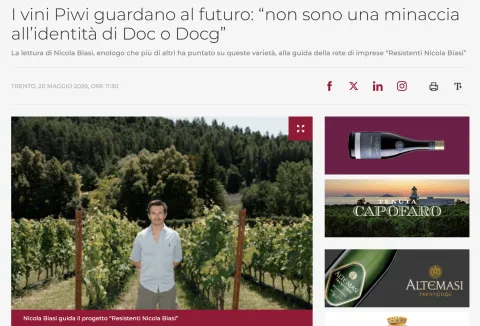
Screenshot of the original article
Article title
I vini Piwi guardano al futuro: “non sono una minaccia all’identità di Doc o Docg”
Link to article
Date of publication
Summary
Nicola Biasi does not really do qualified statements. The “Resistenti Nicola Biasi” network — Albafiorita, Tenuta della Casa in Friuli-Venezia Giulia, Ca’ da Roman, Colle Regina and Poggio Pagnan in Veneto, Oddone Prati in Piemonte, Vin de la Neu in Trentino, and Progetto Mosella in Germany — has been making the same case for a while: resistant grapes are not a threat to Italian wine identity. At a press event in Trento on 20 May 2026, Biasi put it plainly enough. An appellation that panics at the thought of blending in 10–15% of resistant varieties perhaps has an identity not as solid as people think.The regulatory situation is one anyone following this debate will recognise. PIWI cultivation is officially permitted in eight Italian regions — Trentino-Alto Adige, Veneto, Friuli-Venezia Giulia, Lombardia, Emilia-Romagna, Marche, Abruzzo, and Piemonte — yet the total planted area barely reaches 2,000 hectares, nearly all of it clustered in the northeast. The EU would allow resistant varieties into appellations, but Italy’s Testo Unico del Vino (Law 238/2016, art. 33 comma 6) still bars them from DOC and DOCG status, leaving them confined to IGT wines for now. The constraint is not uniform — a multi-varietal DOC has more obvious room for manœuvre than a strictly mono-varietal denomination like Barolo — but either way, the category sits in a kind of waiting room, legally tolerated but not yet admitted to the prestige tier.
The environmental argument for PIWI is real, though Biasi is wary of leaning too hard on it as a selling point. The network’s data points to a 38% reduction in CO2 emissions compared to conventional viticulture, and the practical differences in the vineyard are tangible — fewer tractor passes, less diesel, less compacted soil, vineyard workers handling considerably less chemical spray. Consumers might find all of that interesting, he says, but they will only come back if the wine is good. The real work, in other words, is in the cellar.
There is a cultural argument underneath all of this that tends to get lost. Biasi thinks Italy is too attached to the grape variety and not attached enough to the territory — that the variety should be a vehicle, not the destination. And alongside that runs a more practical frustration: PIWI still gets discussed as though it were a single thing. Souvignier Gris, Johanniter, Bronner, Soreli, Solaris, Cabernet Eidos, Cabernet Cortis — the differences between them are at least as significant as the differences between Merlot, Sangiovese, and Teroldego. None of them are GMOs either, a fact that apparently still needs stating in a sector that treats novelty with suspicion.
Of the varieties, Souvignier Gris is the one Biasi talks about most. He singles it out as particularly significant — good acidity retention, a range of styles from sparkling to macerated, and in his view the clearest evidence that these grapes, vinified properly, can say something about the territory they come from rather than just something about themselves.