A Winegrower Who Stopped Spraying
There is a parcel of vines in Plaissan, a forgettable little commune in the Hérault, that has not seen a synthetic chemical treatment in years. Laurent Cabrol planted it, and he will tell you this is not some ideological gesture — it is just what happens when you choose the right varieties. The vines he put in the ground do not need treating. Simple as that, in his telling.
The number that seems to have set him off is one he quotes on the Viticabrol website: the vine covers 3% of France's agricultural land and accounts for roughly 20% of its pesticide use. The precise figure shifts depending on who is counting and when, but the rough disproportion is not seriously disputed, and it clearly got under his skin. He is a fourth-generation winegrower — the business he runs with his son Gabriel is registered as SAS Viticabrol Père & Fils, at 18 Avenue de Bélarga in Plaissan (34230), though these details come from the site itself rather than from official registry verification. Two timelines float around on the site without ever being reconciled: the homepage says he has been replanting with resistant varieties for 25 years, while the histoire page puts the turning point at around 10 years ago. He never explains the gap. The most plausible reading is that the 25 years covers the family's broader drift away from conventional viticulture, and the 10 years marks the moment he went all in — but that is guesswork.
Resistant Grape Varieties
The catalogue runs to more than 50 varieties in total. Forty-two of these are the disease-resistant interspecific hybrids that are the real point of the business — crosses between Vitis vinifera and American species like Vitis labrusca, Vitis riparia, and Vitis rupestris. The site goes out of its way to clarify that hybrid here has nothing to do with GMOs, which tells you something about the conversations Cabrol has been having with customers.
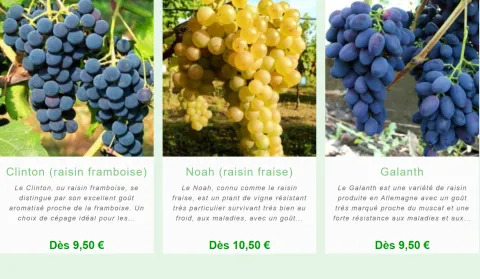
What is on offer is genuinely varied: white, black, rosé, blue; seeded and seedless; early to late season. Names from across the map — Palatina, Muscat Bleu Garnier from Switzerland, Zémira, Angela, Dattier de Saint Vallier, Noah, Isabelle, Concord, Galanth from Germany, Nero and Lidi from Hungary, Arkadia and Souvenir from Ukraine, Kodrianka from Moldova, Phoenix, Jupiter, Suffolk Red, Early Campbell, Clinton, Perdin, Esther, Felicia, and more. His first plants came from Germany and Italy. He says this plainly: French research institutions largely missed the hybrid development wave that their German and Italian counterparts did not miss. That is his reading of it, not an established academic consensus, but it is hard to argue with the provenance of what ended up in his catalogue. He has since picked up grafting material from private collectors and EU nurseries, and the list gets a little longer each season.
The Forbidden Varieties and the Wine That Drives You Mad
Six varieties in the Viticabrol catalogue have been in legal trouble since the 1930s. Noah, Clinton, Othello, Isabelle, Herbemont, and Jacquez — the cépages interdits — cannot be used for commercial wine production in France. You can plant them, eat the fruit, make jam. Wine is where the law draws the line, and it has been drawing it since the interwar years. That said, the picture shifted somewhat in 2021 and 2022, when European and French regulations began opening limited pathways for these varieties — still locked out of AOP and AOC status, but no longer quite as categorically forbidden as before. Small-scale personal production sits in a grey area the legislation has never cleanly addressed.
Cabrol devotes a full page of the Viticabrol site to the history of this ban, and he is not pretending to be neutral about it. The official justification — that these grapes produce wine with dangerous methanol levels — is treated on the site as a cover story. What actually happened, he argues, was a catastrophic overproduction crisis in the interwar years: 91 million hectolitres produced for a population of 34 million, and a political class that needed to shrink supply without admitting that was the goal. The methanol argument is not one he simply dismisses — there is genuine scientific debate about it — but he clearly does not find it convincing. He also flags the documentary Vitis Prohibita by Stephan Balay, which covers this territory, and in which Cabrol himself appears as a contributor — something that has become a significant part of how he is known in the PIWI world. He sells these plants openly, lays out the history for anyone who reads the page, and leaves the conclusion to the reader.
A Geography of Hybrid Origins
Here is something worth sitting with. Of the 42 resistant varieties in the catalogue, France — the country with the most to gain from reducing vineyard pesticide use — contributes exactly two. Eastern Europe contributes seventeen. The United States eight. Germany and Italy five each. Switzerland one. These numbers come from the catalogue as presented on the site; classifying hybrids by national origin is not always straightforward given the international breeding chains involved, so treat the breakdown as indicative rather than definitive.
The site explains how this happened, and it is a good explanation. After phylloxera devastated European vineyards in the late 19th century, French hybridisers — Baco, Seibel, Couderc, Bertille Seyve — did the foundational work of crossing vinifera with American rootstocks to get disease tolerance back into the plant. And then France largely stopped. Other countries picked it up: Germany, Switzerland, and eventually the agricultural research institutes of Hungary, Romania, Serbia, Ukraine, and Moldova, where limited access to synthetic pesticides meant there was a genuine practical need to develop varieties that could survive without them. The result was a new generation of hybrids built on those original French crosses but taken much further — the wild, foxy, almost medicinal character of the early American-influenced grapes mostly bred out, replaced with the kind of sweetness or muscat brightness that European palates recognise. Cabrol makes this point on the site with evident satisfaction. These are not the grapes that gave hybrids a bad name in France. They are a different thing.
The Structure: Father, Son, Greenhouse, Colissimo
Viticabrol is two people. Laurent does the growing and prepares the plants. Gabriel — whose background is in communications and marketing — built the website and handles the commercial side. Orders ship from greenhouses on the family property in Plaissan via Colissimo for standard parcels; larger orders or bigger container sizes may go out with specialist carriers. The range covers bare-root plants and pots from 8cm up to 3 litres. The nursery welcomes visitors by appointment — it is about 10 minutes from Clermont l'Hérault, Gignac, and Pézenas, roughly 45 minutes from Montpellier and Béziers. There is a Spanish-language version of the site, Viticabrol España, for customers across the border. No production figures or turnover numbers are published anywhere on the site.
Media Presence and External Recognition
The histoire page has a press section, and it is more specific than most. Cabrol names the publications, the journalists, the issue numbers — the kind of detail that is either true or very easy to check, which is probably why it is there. Issue 65 of the Chambre d'Agriculture de l'Hérault's quarterly magazine, from 2017, gave Viticabrol a full page on the experimental vineyard and the varieties — Muscat Bleu Garnier, Palatina, Katharina, Villard Blanc, Dattier de Saint Vallier.
Les 4 Saisons ran five pages under the title Une treille au goût de fraise. Thierry Denis mentioned Viticabrol on RTL's gardening programme and named Noah, Perdin, and Esther specifically. Hommes & Plantes gave it six pages in issue 110, written by Jean-Paul Collaert of the Conservatoire des Collections Végétales Spécialisées. Cabrol ran two days of training on resistant varieties through the Vigne en transition network. Midi Libre covered a school project — with the cave coopérative de Sérignan — in which primary and secondary school children planted 150 vines across more than 47 varieties. Dates are missing for some of these on the site, and independent verification was not part of this research.
What Viticabrol Is Not
No certifications. No industry body memberships. No HVE sticker, no ISO number. The site does not claim any of it, which at minimum is consistent — a two-person nursery growing varieties the mainstream has barely heard of does not particularly need a sustainability label to tell you where it stands. The one external data point is a 4.9 out of 5 across more than 500 reviews on Google, Facebook, and Trustpilot. If you are trying to decide whether to order a bare-root Isabelle or a Muscat Bleu Garnier for the back fence, that will probably do.