Brittany Has No Business Growing Vines. Gaëlle Berriau Disagrees.
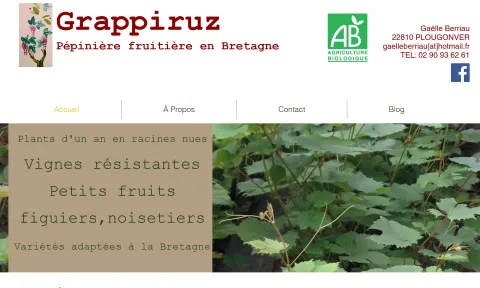
There is a vine nursery in Plougonver, a village in the Côtes-d’Armor near Guingamp, which is in Brittany, which is not supposed to have vine nurseries. Too wet. Too Atlantic. Too much fungal pressure on varieties bred for places with actual summers. Gaëlle Berriau moved there in 2021 from Anjou, where she had worked as a viticulture technician for the Maine-et-Loire growers’ group — later rebranded ATV49 — and then as a winegrower. Company registry records show her down as a vine cultivator from 2012 to around 2016; what she was doing between then and Plougonver is not in any source this research turned up. She came with her eyes open. Her answer to the Brittany problem was not to argue with the climate. It was to find varieties the climate could not touch.
The nursery trades as Grappiruz. Ecocert lists it as certified organic, though the site notes some parcels are still in conversion rather than fully certified, without saying when that changes. Everything is stated to be grown without phytosanitary treatment — and then, a few lines later, the site mentions that resistant varieties might still need one or two treatments in a rough year. Both things can be true at once; it is worth knowing they said both. The registered address is 7 rue de la gare; the nursery is at the Pellegoat site, same commune. Sales are aimed at private individuals, but Berriau also does paid consultancy for professional growers, so it is not quite as simple as retail-only.
Resistant Grape Varieties
The vine catalogue is built around what the site calls hybrides producteurs directs — an older French term that technically refers to the early twentieth-century crosses like Noah and Baco 22A, which are legally restricted or banned for AOC wine production in France. The modern regulatory vocabulary for what Berriau is actually selling is vignes résistantes — a different, legally cleaner category. The language on the site is loose about this, which is worth flagging for anyone thinking about planting for wine rather than just eating the grapes. In practice none of this diminishes the ecological argument for growing these varieties in Brittany. A conventional Vitis vinifera plot here would need spraying so often that for an amateur grower it stops making any sense. And the varieties are early-ripening — not a preference but a hard limit. A variety that finishes in late October around Bordeaux is going to be a very expensive hedge north of Rennes.
The full catalogue is a downloadable PDF rather than a web page, so the variety list requires a small effort to access. Most of what is publicly visible about actual performance comes from the observation network Berriau runs alongside the nursery. A June 2023 post on her blog reports 82 varieties under systematic watch across ten sites in different parts of Brittany — tracking not just mildiou and oïdium but botrytis, anthracnose, and black rot too, plus fertility, growth habit, and ripening dates that actually mean something for a Breton autumn. A France 3 regional report from February 2026 gave one real example of what good looks like: a customer who had grown so much fruit he was pressing juice from what he could not eat.
The Observation Network: Slower Than Sales, More Important
Berriau launched a regional variety observation network in April 2022, following a morning session on resistant varieties in Auray. Nobody made her do it. The data she needed to give growers honest advice about what to plant in Brittany did not exist in a Brittany-specific form, so she started collecting it herself. The network is open to anyone who has planted one or more resistant varieties — working grower, garden hobbyist, person with three vines up a south-facing fence. Members get disease-identification sheets, anonymised results from other growers, an annual synthesis by variety, and a meeting at the end of the season where people compare what actually happened.
What makes the network worth writing about is the tone of her communications around it. She does not promise anything. She writes plainly that it will take years before anyone can say with real confidence which variety produces what kind of wine in which pocket of Brittany. No reassuring headlines borrowed from German or Swiss trials run in different soil and different weather. Whether any institution or researcher has attempted something similar for this specific region is not clear from the sources this article found; what is clear is that nothing equivalent turned up.
Beyond Vines: Small Fruits, Figs, and Rootstocks
Vines get the headline but they are not all of it. Berriau grows more than thirty varieties of small fruits — blackcurrant, casseille, raspberry, redcurrant, gooseberry, kiwai, thornless mulberry, muroise, elderberry, hazelnut — plus fig trees, all tested in Brittany and picked for disease resistance rather than catalogue appeal. There are also rootstock scions for apple, pear, cherry, plum, peach, and quince, medium and strong vigour, chosen for Breton soils. For a broader range of complete fruit trees the website points to Pépinière Frouezh, a partner nursery on the same site; the precise split between what each nursery produces and sells on its own is not spelled out.
Training, Outreach, and the Slow Work of Making Something New
She runs pruning workshops at the nursery — formation pruning, Guyot, cordon, with attention to the cuts that keep wood disease out over the long term. The France 3 report from February 2026 put around twenty people in her Plougonver plot for one of these sessions, working vines in Brittany, which still has an odd quality to it if you grew up thinking Breton wine was a contradiction. In February 2024 she went to Brest and planted fifteen vines beside the Cavale Blanche library with residents from the neighbourhood, children from a local leisure centre, and some city employees who turned up to help. In November 2021 she gave a talk at the Jardin Passion Lannion society and told them to watch Vitis Prohibita, Stephan Balay’s 2019 documentary on the history of resistant varieties in France — the film that explains why what she is doing in Plougonver was nearly impossible to do for most of the twentieth century.
The Vignerons Bretons association covers the region’s viticulture and keeps citing Grappiruz. Berriau has become the person people call when they want to know whether a vine will actually survive a Breton winter and produce something in September. The vine survives. The question of what it eventually produces, and whether anyone will want to drink it, is what the network is quietly working out.