What is the origin?
Some grapes turn up with a story. A mutation discovered in a single row in 1846. A vine smuggled in a monk's pocket. A clone identified in a derelict vineyard outside Beaune by some viticulturist who has been there too many times to count. Accent has none of that. What it has is a serial number, Gm 8230-2, a year, 1982, and the address of a research institute in the Rheingau.
The institute is Geisenheim. The director was Helmut Becker, who ran the breeding programme there until his death in 1990 and never saw this one through to release. Late-twentieth-century German viticulture is full of unfinished work like that — programmes outliving their programme directors, grapes parked in trial blocks waiting on someone to decide what to do with them. Becker's name still gets stamped on plenty of commercial clones planted today. Accent isn't one of his hits.
Kolor brings the colour. It's a teinturier with Pinot Noir blood and red flesh, and it sits in Geisenheim's breeding records without having accumulated much of a presence in the major ampelographic databases — the kind of gap that opens when a variety never makes it beyond the trial block into anything that would force someone to write it up properly. What it contributes genetically to Accent's pigmentation hasn't been published. The red juice, though, is not in question. The other parent is Chancellor, formerly Seibel 7053 — that Seibel, Albert Seibel, the nineteenth-century French hybridiser whose lines still run underneath a startling number of resistant varieties across central Europe and North America. Chancellor is Seibel 5163 × Seibel 880, so the non-Vitis vinifera blood that does the actual work against fungal pressure comes from that side. Worth noting: Chancellor is also a parent of Regent, Germany's most commercially successful PIWI red, which puts Accent and Regent in the same Geisenheim generation, bred out of the same idea — use Chancellor as a bridge to carry North American resistance genes into the Vitis vinifera pool. Regent worked out. Accent is the other one.
Classical crossing, no marker assistance; that came to Geisenheim in the 2000s. What's since been confirmed through the Vitis International Variety Catalogue is that SSR marker data exists, the pedigree has been verified, and two resistance loci are formally documented: Ren3 and Ren9, both from the Chancellor side. The vinifera percentage isn't published.
On the paperwork: submitted to the Bundessortenamt in 2003, granted Community Plant Variety Rights at EU level in 2007 — EU protection routinely runs ahead of national listing — and registered in Germany in 2010. Registered in the EU Common Catalogue too. The VIVC records Akkent as a recognised synonym. Beyond the breeding number written two ways there are no regional variants worth listing.
What is it resistant to?
The Geisenheim datasheet gives Accent high resistance to powdery mildew, good-to-sufficient tolerance against downy, and high resistance to Botrytis cinerea. Two fungicide sprays a year is the baseline the institute recommends — against eight to twelve in a conventional German vineyard running Pinot or Riesling, depending on vintage and how wet the autumn turns out. A real reduction. How real depends on your site and your season, but the gap is not a marginal one.
Part of the botrytis story is genetic. Part of it is just architecture. Loose cluster, well-shouldered shape, firm stems, bloom-dusted berries that don't rupture each other into a rotting mass when the autumn rain shows up. Mechanical, almost.
The resistance loci have names now: Ren3 and Ren9, confirmed in the VIVC, both inherited through Chancellor and its Seibel heritage. How durable they are against newer races of Plasmopara viticola or Erysiphe necator isn't addressed in anything published on Accent specifically. Wein.plus and the Geisenheim datasheet order the two mildew resistances slightly differently, which happens when different protocols meet the same variety at different points in time; both agree the resistance is real and worth something.
The questions a grower would actually ask — copper sensitivity in organic blocks, leafhopper behaviour relative to a Pinot parcel next door, phylloxera response — none of that is in print. Accent has resistance. It doesn't have the fully mapped profile the newer PIWIs arrive with, and for some growers that gap matters more than the spray count.
How does it adapt to climate and what is its ripening profile?
Late ripening. Very late. The breeder puts harvest past Pinot Noir and closer to Cabernet Sauvignon, which in a German context is genuinely demanding — Pinot already pushes the cool-climate envelope, and Cabernet can sit underripe in all but the warmest German sites. Accent needs a warm, extended autumn.
Bud break and flowering run late, which helps against spring frost: by the time Accent has any green tissue out, the worst frost windows in the Pfalz or Rheinhessen have usually closed. The same loose, firm-stemmed cluster that keeps botrytis at bay lets fruit hang into late October without falling apart. Site requirements are rated medium to high. Warm slopes, not cold north-facing parcels.
Beyond that the data dries up. No Winkler or Huglin targets, no drought tolerance figures, no frost-hardiness rating beyond the soft note about late bud break. The institute either didn't run those trials or didn't publish them. Either way, nobody else has filled the gap.
How does it grow in the vineyard?
Vigour: medium to strong. The thing that catches growers out is the lateral-shoot habit. Accent throws Geiztriebe — those secondary shoots that keep appearing through summer — and throws them hard. Skip a leaf-pulling round in July and the canopy closes into something that's bad for ripening, worse for spray penetration, and an open invitation to botrytis the moment it rains. Stay on top of it and the variety is not difficult.
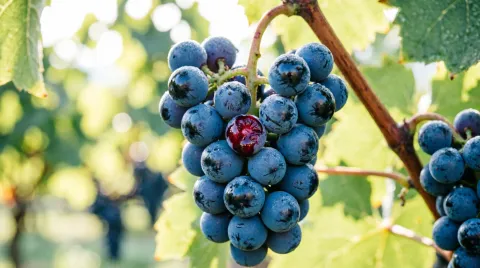
The cluster is genuinely forgiving. Loose, well-shouldered, firm-stemmed, blue-black berries that bleed red the moment the skin breaks. Yield sits at roughly 120 to 140 decitonnes per hectare in Bundessortenamt trials — slightly below Pinot Noir under comparable conditions, so not a variety that robs you of volume while giving you colour.
After that, the record gets thin. Nothing on preferred soils. No rootstock recommendation, which is unusual — most German varieties carry at least an SO4-or-5BB note somewhere. Coulure and millerandage aren't mentioned, which could mean the variety is unproblematic or could mean nobody looked closely enough to say. Trial pruning is Guyot. Whether it takes to Cordon de Royat or anything else is undocumented. A bred variety, but not a benchmarked one. Never enough commercial weight behind it to push for those answers.
How does the wine taste?
This is what Accent was designed for. Must analysis from Geisenheim puts Mostgewicht in the moderate-to-high range, acidity moderate. Not an over-sugared bomb, not a thin skeleton. The interest is in the wine.
A study at LVWO Weinsberg covering vintages 2022 to 2024 compared twelve PIWI reds for phenolic content. Accent came out near the top for anthocyanins. The values spread across a wide range — clone, vintage, and extraction method all varying at once — so a single number would mislead. The tannin data is harder to argue with: levels ran roughly double those in the Pinot Noir and Blauer Limberger control wines. Extraction differences don't account for a gap that size.
Geisenheim's own descriptors are stripped back: well-covering dark red, dense tannin, pronounced vanilla aroma. The vanilla is the strange one. It shows up in young wines with no oak contact. Where it comes from — whether it's varietal, phenolic, something else — hasn't been established in published research. Whether it survives in bottle isn't rated. Ageing potential, sparkling suitability, base-wine potential: all absent from the record, which is frustrating because the tannin levels alone suggest something interesting might happen with time.
As a blending tool, Accent does what Alicante Bouschet and the older French teinturiers did in the south of France for decades — fixes pale, under-extracted wines without asking for credit. The few pure-Accent bottlings that surface from German growers tend to be dark, vanilla-forward, slightly rustic, rarely complex. Wines made to prove something. Not wines you sit down with for an evening.
What is the distribution, regulatory status and market development?
Fifteen years after registration, no widely cited plantings figure exists for Accent. It doesn't appear in the rounded-off hectarage tables of any German region. Could be a dozen hectares. Could be three. The Beschreibende Sortenliste lists it, so commercial planting in Germany is legal. The EU Common Catalogue registration is confirmed. The 2007 Community Plant Variety Rights date, which the original text flagged as unresolved, is corroborated by both the VIVC and wein.plus independently — it precedes the 2010 German listing because EU protection and national registration run on separate tracks and separate timelines. Outside Germany, Accent is registered in Switzerland and grown there by a small number of boutique producers in the German-speaking cantons. Whether it appears in any other EU member state register isn't confirmed anywhere publicly accessible.
The PDO question is worth separating into its actual parts, because growers and importers regularly muddle them. Can you plant inside a PDO zone? Can you make commercial PDO wine from it? Can the grape appear on the front label? Accent clears the first gate in Germany, mostly as a Deckwein component. Gates two and three, anywhere, are undocumented — which means untested, not prohibited, but the distinction doesn't help much in practice.
The real brake on adoption isn't legal. The pathway for using Accent as a teinturier inside German blends exists. The brake is commercial, and it feeds on itself: no consumer identity, no label presence, no reason for a grower to give up rows that could carry something with a name people recognise. Forty years from crossing and the variety is still waiting for someone to decide it deserves to be on the front of the bottle.
Market presence
The following figures are generated by our PIWI bot, which identifies nurseries, estates and their wines made from this grape variety.
Which estates and wines stand out?
There isn't one. No internationally regarded estate has committed to Accent. No major awards for a varietal bottling in any year on record. No Michelin-level wine list with it on there, going by public-facing lists. The Swiss boutique producers are working with it experimentally, but nothing has reached a profile that would bring the variety to wider attention. It lives inside other people's bottles, doing colour correction, anonymously. Fifteen years after registration, that's the truth of it. If someone is making the wine that ends up in a Decanter feature in 2030, they haven't started yet.
What is the future outlook?
Two scenarios. The optimistic one: as the German wine map shifts under climate pressure, late-ripening teinturiers find their moment. Sites in the Pfalz and Rheinhessen that used to struggle with Cabernet now push Accent past the line, and growers tired of pale, copper-heavy organic blends reach for something that has been sitting on the shelf since 2010, with confirmed resistance loci and a spray programme that doesn't require a second mortgage.
The pessimistic scenario is louder, and probably more realistic. Newer PIWI reds — Cabernet Cortis, Cabernet Carbon, Pinotin, Cabertin — deliver dark colour and dense tannin alongside cleaner varietal aromatics and better-documented resistance profiles. Some carry Rpv loci alongside Ren genes. Accent, made by classical crossing in 1982, doesn't have that depth of published characterisation, and the growers who care about documentation are increasingly the ones who matter.
No flagship wine. Negligible varietal identity. A planted area too small to show up in regional statistics. Nearly thirty years from crossing to commercial registration, and the variety still hasn't broken out. Hard to see what changes in the next ten.