A Vineyard in the Dutch River Landscape
The Betuwe is fruit country more than wine country — or it was. The strip of Gelderland between the Rhine and the Waal has always grown things well, and somewhere in that logic Diederik Beker and Arina van Leenen decided in 2004 to plant vines at Burensewal 5 in Erichem, a quiet village near Buren, close to the small river Linge. The estate's website puts the size at 7 hectares with over 21,500 vines, though some sources suggest the planted area has grown beyond that in recent years — the exact current figure is not confirmed. Either way it sits comfortably among the larger producers in a Dutch wine sector that now numbers around 175 estates. The estate describes its approach as artisanal, sustainable, and nature-inclusive. Given the grape varieties they chose to grow, that rings true.
The Wines and the Varieties behind Them
Every grape at Betuws Wijndomein is a fungal disease-resistant PIWI variety. In a wet northern climate that is less a philosophy than a sensible decision, though it produces wines that hold their own well beyond the Netherlands.
The white wines go out under the LingeWit label. Johanniter runs through much of the range — a single-variety bottling with apple and citrus character, a Cuvée and a Cuvée Barrique both blended with Solaris and Souvignier Gris, the barrique version aged in new oak. Cabernet Blanc is vinified on its own as LingeWit Sauvi — spicy, with flint and passion fruit. The Blanc de Noir is pressed immediately from Pinotin and Cabernet Cortis, giving a pale wine with more structure than its colour suggests. Jasmijn is an orange wine from Souvignier Gris fermented on its skins and aged nine months in old barriques. Muscaris also features, most notably in the LingeWit Edelzoet, a dessert wine.
The reds are LingeRood, built on Regent, Pinotin, and Cabernet Cortis, with strict selection before harvest and twelve months in 225-litre barriques for the barrel-aged versions. LingeBruut is a traditional-method sparkling wine from Johanniter — second fermentation in the bottle, 24 months on the lees, properly done. The LingeParels are lighter sparkling wines in white and rosé. Prepluk Verjus, pressed from unripe early-harvest grapes, and the Firma Bruis non-alcoholic range — Betuwse Bruis, HopHout, and VeldFlora — round out a portfolio that covers more ground than the hectares would suggest. Everything is picked by hand.
Awards
In 2017 Diederik Beker was named Winemaker of the Year at the Wijnkeuring van de Lage Landen, the main competition for wines of the Low Countries. In 2021 the estate took the best vineyard title across the 2017–2021 vintages at the same event. At PIWI International 2018, five wines took gold — both LingeRood cuvées from 2016, both main LingeWit cuvées from 2017, and the Blanc de Noir — with several others picking up silver at the same competition and at the Wijnkeuring that year. The estate's own website acknowledges that results from more recent years have not yet been added, so the published list stops well short of the current picture.
Buying the Wines
Orders go by email to info@betuwswijndomein.nl, with delivery through Vinologix, a specialist wine courier, in boxes of six (€12.50) or twelve (€14.50) bottles. The website does not specify whether shipping extends beyond the Netherlands. The on-site shop in Erichem is open Wednesday through Saturday, noon to 17:00. A tasting box of six wines from the 2022 and 2023 vintages — Proefbox: Wijn van de Lage Landen — runs to €104 including delivery. Wine shops, restaurants, and wine bars stocking the range are listed on the estate website. Prices are those of April 2026.
The Estate as a Place to Visit
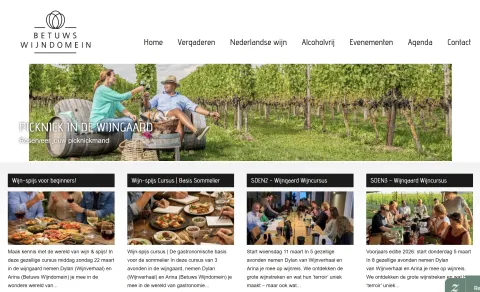
Beyond the bottles, Betuws Wijndomein has become a genuine destination. The 2026 calendar runs to vineyard dinners, cooking workshops, wine-and-food pairing evenings with local wine educator Wijnverhaal, weekend tastings, vineyard tours by a small harvest train called a pluktrein, and weddings in the vines. Corporate groups can book half-day or full-day packages ending with a tour and tasting led by Diederik. It is a full operation — and for a small Dutch estate, probably what keeps the whole thing turning. On the evidence of the medals, the wines make it worth the detour.