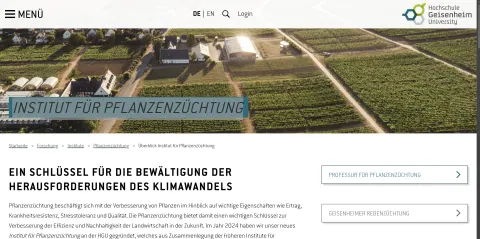
One of the Oldest Vine Breeding Institutes in Germany
Heinrich Eduard von Lade was a banker, a philanthropist, and apparently a man who knew how to make things happen. In 1872 he persuaded the Prussian state to fund a research institute for pomology and viticulture in his hometown of Geisenheim, on the northern bank of the Rhine in the Rheingau. Whether the Prussians needed much persuading is unclear — the region had been growing wine seriously for centuries, and there was real economic logic to putting science behind it. Either way, the institute opened, and four years later a Swiss professor named Hermann Müller arrived on staff.
Müller’s name is attached to what became Germany’s most-planted grape variety in the 1970s, though the story is messier than it first appears. He did the actual crossing work in 1882 at the research station in Wädenswil, Switzerland, not in Geisenheim. The variety — Müller-Thurgau, named for him and his home canton — was believed for decades to be Riesling × Silvaner, which is why it is still often sold under the name Rivaner. DNA analysis eventually showed it is actually Riesling × Madeleine Royale. Its planted area in Germany has dropped considerably from its peak. None of this diminishes what the institute went on to become, but it is a good early indication that vine breeding rarely goes quite the way anyone expects.
Helmut Becker and the Decades That Shaped PIWI Viticulture
Helmut Becker arrived at Geisenheim in 1964 and ran the Institute for Vine Breeding until he died on 19 July 1990. Twenty-six years. His central argument — that breeding disease resistance into the vine was the only approach that would hold in the long run, that spraying was a habit not a solution — was not universally popular when he started making it, and he made it anyway.
What gave his breeding programme its particular character was where he found resistance. Eastern European and Soviet breeders had been working for some time with germplasm from Vitis amurensis, a wild species from the Russian Far East with strong cold tolerance and useful mildew resistance. Becker brought that material into Geisenheim’s programme — often through intermediary varieties, not direct crossing, but the genetic contribution shows up in the pedigrees of several of the varieties he helped develop.
Rondo is the one people tend to know. It was bred by Czech scientist Vilém Kraus — Zarya Severa crossed with St. Laurent — and during the Cold War, Kraus found a way to get seeds to Becker. This was not a simple thing. Scientific exchange across the Iron Curtain moved slowly and with complications, and the fact that these seeds made it to Geisenheim at all says something about the networks Becker had built. The seedling population was designated Gm 6494; from it came Gm 6494-5, which Geisenheim selected and propagated before it was registered as Rondo in the mid-1990s. It is now grown across Denmark, England, Ireland, and the Netherlands — a deeply coloured, full-bodied red that Becker did not invent so much as recognise and bring forward. He had a talent for that. His other contributions to the register include Dakapo, Ehrenbreitsteiner, Prinzipal, Reichensteiner, and Saphira.
Teaching, Research, and Forty Years Apart
Until 1971, Geisenheim combined teaching and research in the same building, more or less. That year the two were formally separated: teaching transferred to the newly founded Fachhochschule Wiesbaden, research stayed put. Both sides got on with their own work for over four decades.
In January 2013 they merged again. Hochschule Geisenheim University — HGU — came into being through the union of the Geisenheim Research Institute and the Geisenheim faculty of the RheinMain University of Applied Sciences. The Wissenschaftsrat, Germany’s Council of Science and Humanities, had assessed the project and given it the go-ahead. Today the university runs six research centres and 19 institutes and working groups, employs around 434 staff including 43 professors, and draws students from over 50 countries into programmes covering viticulture, enology, beverage technology, horticulture, food safety, and landscape architecture.
The 2024 Reorganisation and What It Signals
Last year the departments for grapevine breeding and molecular plant sciences were brought together into a single Department of Plant Breeding. On paper this looks administrative. In practice it reflects something real about where the science is going — breeding programmes that still depend primarily on looking at vines in a field and picking the best ones are losing ground to approaches that can predict performance from sequence data before a vine has been planted. The new department is set up for both: eleven hectares of experimental vineyards on one hand, genomics labs and bioinformatics infrastructure on the other. Around 40 people work there, across every level from BSc students to senior researchers.
Kai Voss-Fels, and the Funding That Made It Possible
In 2023, Prof. Dr. Kai Peter Voss-Fels was appointed to the Professorship for Grapevine Breeding and brought with him Geisenheim’s first LOEWE Start Professorship — nearly 2 million euros over six years from the Hessian state. The departmental reorganisation in 2024 was built partly around what that funding made possible.
Voss-Fels did not come up through viticulture. His PhD was in quantitative genetics in wheat, finished at Justus-Liebig-Universität Gießen in 2016. After that he spent four years at the University of Queensland, became Honorary Associate Professor there in 2021, and published more than 40 peer-reviewed papers across wheat, barley, canola, and sugarcane before turning his attention to Vitis. The journals include Nature, Nature Plants, and Trends in Plant Science.
At Geisenheim his group is doing things like using Nanopore long-read sequencing to map how Pinot noir diverges genetically and epigenetically across centuries of clonal propagation — working out which of those differences are actually heritable and which are noise, and what that means for selection. The LOEWE money is also funding an expansion into fruit and vegetable breeding, which is a wider mandate than the institute has historically taken on.
The PIWI Work That Continues
Geisenheim is a registered member of PIWI International, listed at Von-Lade-Str. 1 — which is, as it happens, the same address the institute has occupied since 1872. The current research makes the membership more than a formality.
VITIFIT, a project funded by the Federal Ministry of Food and Agriculture running through 2025, is working on downy mildew control in organic viticulture with PIWIs as a central component. The context matters here: copper-based fungicides are heavily restricted, climate change is raising disease pressure year on year, and organic growers in Germany are under real financial strain. The project tests copper minimisation techniques, plant extracts, and UVC technology, and it specifically targets new resistance loci against Plasmopara viticola for integration into breeding lines. New fungus-tolerant varieties are the goal, not just better management of the old ones.
Alongside this, a project running 2024 to 2027 and funded by the Forschungsring des Deutschen Weinbaus looks at how arbuscular mycorrhizal fungi affect vine fitness under drought, with the Institute handling the rootstock grafting work. The question of drought tolerance and the question of disease resistance are starting to overlap in ways they did not used to — PIWI varieties are the ones growers reach for when they want to reduce chemical inputs, and those same varieties need to cope with increasingly difficult summers. Commercially, PIWI varieties still hold a modest share of German plantings, slowed by wine law classifications and a market that has moved cautiously. The research runs well ahead of the planting statistics.
Where Things Stand
The remark that has followed Geisenheim for decades — “To call oneself a Geisenheimer is almost equal to receiving a knighthood” — has no clearly documented source, but it persists. Looking at what the institution has actually produced since von Lade opened the doors in 1872, it is not entirely surprising that it stuck. The crossing that reshaped German viticulture for a century, even if the parentage turned out to be something other than expected. The Cold War seed exchanges that eventually put Rondo in vineyards from the Netherlands to the west of England. The genomic tools now being applied to clonal variation in varieties that have been propagated for hundreds of years. These are not chapters in an institutional brochure. They are what happened when scientists at a particular address in the Rheingau kept working on the same set of problems across a very long stretch of time. The address is still there. So is the work.