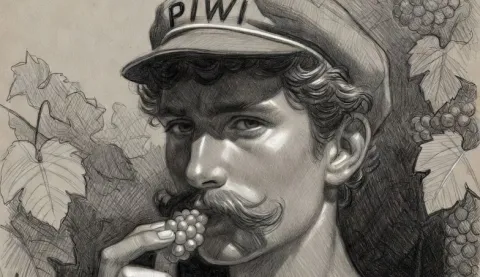
A gendarme's son with viticultural blood
The story of François Baco begins not in a laboratory or a prestigious agricultural college but in the gendarmerie of the Landes département. Born on 11 May 1865 in Peyrehorade, a market town on the Gave de Pau river in southwestern France, Baco was the son of Augustin François Baco, a mounted gendarme who had settled in the region through marriage. His mother, Marie Campagnolle, came from a farming family in Orthevielle. The paternal line, however, traced back several generations to viticultural families rooted in Marquixanes in the Pyrénées-Orientales, the probable origin of the Baco surname itself, where documented agricultural roots help make sense of what the family passed on. That inheritance was not an abstraction. It was in the soil of Baco's upbringing, long before he ever conducted a deliberate crossing experiment.
He arrived at the school of Montfort en Chalosse in 1877 as a pupil, already absorbing the lessons of teachers who took agriculture seriously as a discipline. One of them, Pierre-Xavier Lalanne, taught at Peyrehorade from 1865 to 1889 and appears to have made a lasting impression. The Landes was farming country, and the best teachers treated it that way.
A schoolteacher with a second vocation
Baco obtained his first teaching post in 1885, at just twenty years old, as an assistant teacher at Lesperon. Over the following years he moved through a series of postings across the Landes: Villeneuve de Marsan, Dax, Labatut, Soustons, Morcenx, Pontonx. In 1892 he married Jeanne Destouesse in Morcenx, and the following year he arrived in Bélus, where he would spend the rest of his active career. He was both schoolteacher and secretary of the local municipality, two demanding jobs that left him almost no obvious margin for experimental viticulture. He found it anyway. He made the school garden at Bélus a living laboratory, and his classroom notebooks, which survive and have been described by local historians as scientifically rigorous, were illustrated with detailed drawings of his own hand. His teaching career ran from 1885 to 1923. Before those books appeared in print, he had already been disseminating findings through viticultural journals in the early years of the century, which gives some measure of how seriously the professional community had begun to take him.
What pushed him from theoretical interest to hands-on breeding was the devastation unfolding around him. Phylloxera, the root louse introduced from North America, had been destroying French vineyards since the 1860s. By the time Baco settled in Bélus, the commune was already badly damaged. Then, in 1896, black rot arrived, a fungal disease that compounded the catastrophe. The vineyards of the Landes, source of the base wines for Armagnac production, were collapsing. Baco recognized that grafting European Vitis vinifera vines onto American rootstocks, the solution being promoted by agronomists, was not working reliably for every variety. Folle blanche, the dominant distillation grape of Armagnac and Cognac, performed poorly when grafted, showing low yields and pronounced susceptibility to disease even when the graft itself took. Something more radical was required.
Fifty thousand seeds and a broken leg
There is a detail in the local record that tells you something about how Baco's breeding program crystallized. On 14 October 1894, he fell from his bicycle on the steep hill at Bélus and fractured his leg, leaving him immobilized for more than thirty days. Whether the enforced rest hardened his resolve about hybridization, as local historians have speculated, is not provable. What is certain is that within a few years he had designed and executed an experiment of formidable scale for a village schoolteacher with no institutional support. He learned professional grafting techniques and worked in close collaboration with Étienne Lacausse, whose family owned the Nassy estate in Bélus. It was on those Lacausse vines that the 22A — the variety that would become Baco blanc — was ultimately developed. He also worked with Jules Darrigan, a friend whose nursery at the Grand Boué estate in Labatut multiplied and commercialized the resulting cépages.
The process was systematic and exhausting. Baco artificially fertilized around 1,200 inflorescences, planted approximately 50,000 grape seeds, and then selected from the resulting seedlings over several years. From more than 50,000 cuttings he identified around 7,000 candidates of interest, and from those he ultimately released a number of varieties to the market, commercialized worldwide from 1912 to 1960. Sources differ on the exact count — figures between six and ten appear in the literature — and while local records from Labatut have been cited in favour of eight, no complete independently verified catalogue has been published. The numbers alone make the achievement remarkable regardless. This was not a lucky cross. It was a sustained programme of applied science conducted outside any official research institution, by a man with a full-time teaching job, on borrowed land.
Two varieties, two fates
The first significant result came in 1902, when Baco crossed Folle blanche with a member of the Vitis riparia species from North America, most often identified in viticultural literature as V. riparia Grand Glabre, also known as Riparia Gloire de Montpellier. The parentage remains a point of ongoing discussion: Grand Glabre bears only female flowers, which complicates straightforward attribution, and the matter has not been fully resolved even by more recent ampelographic work. The resulting dark-skinned hybrid is now known universally as Baco noir. It was commercially released in 1910 and subsequently planted across Burgundy, Anjou, and the Landes itself. Some secondary sources cite 1894 as the creation date, apparently conflating it with the year of Baco's bicycle accident, but the weight of ampelographic sources supports 1902, and no primary breeding records have been produced to establish an earlier date.
Baco noir was an early budding variety, which made it vulnerable to spring frosts, but it showed genuine resistance to downy and powdery mildews. Crucially, unlike most hybrids that crossed riparia genetics, it lacked the aggressive foxy character that made other varieties unpalatable as table wine. The second variety, and the one that would define Baco's historical reputation, emerged in 1898. He crossed Folle blanche with Noah — itself a hybrid of Vitis labrusca and Vitis riparia — though it should be noted that some subsequent ampelographic research has questioned the Noah attribution for this cross, suggesting a V. riparia selection as the more likely paternal parent; the parentage of 22A, like that of Baco noir, remains a live question in the literature. The resulting white grape was designated number 22A in his experimental vineyard — the twenty-second vine in row A — and Baco named it Maurice Baco, after his son who had died at the age of seventeen. The grape bearing a dead boy's name would eventually cover substantial portions of the Armagnac region at its peak in the 1970s, representing the dominant share of all plantings there.
Saved, then squeezed out
The rise of Baco blanc in Armagnac was rapid and, for several decades, total. Folle blanche had failed to adapt reliably to American rootstocks and remained dangerously susceptible to grey rot and black rot. Baco blanc preserved much of the neutral distillation character that made Folle blanche desirable while shedding the worst of its fragility. Armagnac producers adopted it with genuine enthusiasm, not official pressure, and for most of the twentieth century it was the de facto grape of the appellation. As of 2005, the Bureau National Interprofessionnel de l'Armagnac reported it was still used in the production of nearly half of all Armagnac. A 2022 assessment confirmed it still accounted for approximately 47 percent of the appellation's surface area.
The regulatory story is less flattering. The creation of France's Appellation d'Origine Contrôlée system in the 1930s was built explicitly around pure Vitis vinifera varieties. Hybrids were structurally excluded from the prestige tier, and Baco noir, despite its genuine quality in the right hands, was gradually pushed out of French viticulture. Regulatory pressure on Baco blanc accumulated through ongoing negotiations, exemptions, and phased reconsideration rather than through any single clean decree, but the direction was clear: hybrids were unwelcome. Advocates for the variety's historical role in Armagnac mounted a successful defense, and Baco blanc was confirmed as one of ten authorized grape varieties for the Armagnac AOC by decree in 2005, with transitional planting restrictions continuing to shape its recovery in the years that followed. It remains the only hybrid variety to hold historical authorized status in the French appellation system, though more recent regulatory changes have begun permitting newer resistant varieties under strict percentage limits in some other AOCs. Baco noir had no such champion in France. By 2008 its French plantings had fallen to approximately 28 acres. Its survival story belongs to North America, not the Landes.
The North American afterlife
Baco noir found its way to North America in the early 1950s and found terrain that suited it far better than the bureaucratic architecture of French appellation law. New York's Finger Lakes, Michigan, Ontario, Nova Scotia, and Oregon all became significant planting zones. The variety thrives in cool climates where Vitis vinifera cannot reliably ripen. One of the more notable examples of regional adoption came at Henry of Pelham winery in Ontario's Niagara Peninsula, where co-founders Paul, Matt, and Daniel Speck planted some of the oldest surviving Baco noir vines in Ontario in 1984 on the Short Hills Bench. The variety also attracted interest in California's Sonoma Coast, where at least one producer has demonstrated that it can survive in unexpectedly Mediterranean conditions. Baco blanc also found limited footing in North America during the mid-twentieth century, including in California for brandy production, though it never achieved the same regional identity there that Baco noir developed in the northeast and Great Lakes zones. François Baco died in 1947, before the North American adoption was fully underway. Whether he would have recognized the wines his Baco noir produced in upstate New York as anything resembling his original intentions is an open question.
Publications
Baco was a productive author in his retirement. In 1925 he published Précis complet de viticulture moderne et de vinification, a comprehensive practical manual on modern viticulture and winemaking, issued under his own name from Labatut. In 1926 he followed it with De l'hybridation méthodique de la vigne, a more technical work setting out the methodological principles behind his crossing programme. In 1936, a decade before his death, he published Pour la défense de la viticulture, sur les appellations d'origine du Cognac et de l'Armagnac et pour la défense de l'Armagnac — a polemical work defending both his varieties and the Armagnac appellation against the regulatory pressures that were already beginning to squeeze hybrids out of official French viticulture. Earlier research writings are cited as having appeared around 1904, and his findings had also been disseminated through viticultural journals before that date, though comprehensive bibliographic access to those earlier texts remains limited.
Recognition and memory
French officialdom was slow to acknowledge what Baco had accomplished. He was awarded the Palmes Académiques for his teaching work, and made Chevalier de l'Ordre du Mérite Agricole in 1910, which recognized his agricultural contribution without exactly placing it at the summit of national honours. The Légion d'Honneur — specifically the grade of Chevalier, awarded for a combination of his viticultural and teaching work — came in October 1946, a few months before his death on 17 March 1947 in Labatut, at the age of eighty-one. In September 1952, five years after his death, a monument was erected in his memory in the village of Bélus, inaugurated by the minister Guy Petit. The bust was sculpted by J. Dulau, a Grand Prix de Rome laureate, working from a portrait by the Peyrehorade painter Victor Séris. The sculpture shows Baco's face above scenes from vineyard work. The primary school in Labatut bears his name. A commemorative publication, Hommage à François Baco, was issued in 2006 by the association Trait d'Union in Labatut, drawing on local archival research.
The study that placed him in academic context
The most thorough scholarly treatment of Baco's work to date is a paper published in 2011 in the journal Territorios del Vino, titled Les créations de François Baco (1898–2011): Naissance et destin d'une collection d'hybrides producteurs directs français. The paper traces the creation process of the entire Baco hybrid collection and follows the global trajectories of his varieties, examining why some survived and others disappeared. The analysis frames Baco's case as a lens for understanding the cultural and regulatory construction of what counts as a legitimate grape variety — the difference between a vine that saves a vineyard and a vine that the appellation system will actually permit. His hybrids were cultivated across multiple continents while their creator remained a local figure in a small corner of the Landes. The paper establishes that with documentary precision. It is, in the end, the story of how one man's solution was adopted widely and credited almost nowhere.