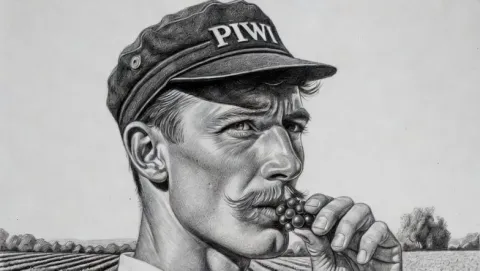
A breeder born into the crisis
Eugène Kuhlmann was born in 1859 in Alsace — a region that, by the time he came of professional age, was both politically occupied and viticulturally devastated. The German annexation of Alsace-Lorraine following the Franco-Prussian War of 1870–71 placed the Institut Viticole Oberlin in Colmar, where Kuhlmann would spend his career, technically on German soil. Simultaneously, the arrival of the North American root louse Daktulosphaira vitifoliae — phylloxera — had begun its destruction of European vineyards, followed by powdery mildew (Uncinula necator) and downy mildew (Plasmopara viticola). While grafting onto American rootstocks became the industry standard for phylloxera, Kuhlmann focused on interspecific hybrids to combat the fungal pathogens and extreme cold that still threatened production. Kuhlmann's personal biography beyond these broad strokes is sparsely documented. What is recorded is that he was an industrialist by original training and that he became the son-in-law and private secretary of Christian Oberlin (1831–1915), the engineer who had founded the Institut Viticole Oberlin. This family connection placed Kuhlmann at the center of a consequential private breeding program. Working both at the institute and his own nursery in Kienheim, Kuhlmann refined the foundations laid by Oberlin. He was not the sole savior of European wine, as the crisis was largely mitigated by grafting, but he was a pioneer in creating "direct producers" that required fewer chemical treatments against mildew.
The institute and the man who inherited it
The Institut Viticole Oberlin was a private establishment founded by Christian Oberlin to cross, select, and disseminate new grape varieties. By 1904, roughly 1,200 different varieties were under evaluation. Kuhlmann joined this institution through marriage and gradually took on a central role. When Christian Oberlin died in 1915, Kuhlmann assumed the directorship of the institute, a position he held until 1926. It was during this period — which coincided with World War I and the return of Alsace to France — that his most famous varieties were finalized. The political restoration of Alsace in 1918 influenced the naming of his work. Several of Kuhlmann's most celebrated varieties were named to honor the French victory. Maréchal Foch, officially designated as Kuhlmann 188-2, was named after Ferdinand Foch, the Supreme Allied Commander. Similarly, Maréchal Joffre (Kuhlmann 187-1) honored the hero of the Marne. These names were affirmations of French identity for vines bred under German sovereignty. While these hybrids were later criticized in Europe for "foxy" flavors and restricted by early European Union regulations, their hardiness made them indispensable in harsher climates across the Atlantic.
The method: a numbering system as a scientific statement
Kuhlmann's approach was systematic. He assigned every crossing a numerical code — his surname followed by a crossing and selection number. His primary breeding material involved complex crosses. A frequent parent was Millardet et de Grasset 101-14 OP (an open-pollinated seedling of a Vitis riparia x Vitis rupestris rootstock), which he pollinated with Goldriesling. Goldriesling was itself a Vitis vinifera variety created by Oberlin from Riesling and Courtillier Musqué. This pairing provided a mix of American disease resistance and European wine quality, though the exact lineage of varieties like Maréchal Foch remains a subject of scientific debate due to incomplete wartime records. His program produced more than 36 registered cultivars, including Léon Millot (Kuhlmann 194-2), Triomphe d'Alsace (Kuhlmann 319-3), and Lucie Kuhlmann (Kuhlmann 149-3). The latter was named after either his wife or daughter, a common practice among breeders of the era. This code system declared that grape breeding was a scientific enterprise rather than a horticultural accident. By using the 101-14 rootstock genetics as a breeding parent rather than just a base for grafting, Kuhlmann sought to bake resistance directly into the fruit-bearing vine, creating plants that could survive without the intensive chemical regimens required by pure Vitis vinifera.
The varieties that survived him
Of Kuhlmann's cultivars, a core group remains in active cultivation, mostly outside France. Maréchal Foch is grown in Canada and American states like Oregon and New York. Léon Millot occupies small plantings in Switzerland and the Pacific Northwest, while Triomphe d'Alsace is found in the United Kingdom. Within France, these varieties were historically excluded from the appellation system, which left no room for interspecific crosses. However, modern interest in sustainable viticulture has led to a slight softening of these restrictions, as breeders look back at Kuhlmann’s work to find genetic solutions for reducing pesticide use in modern vineyards.
The Blattner chain: Kuhlmann's genetic afterlife
The most direct evidence of Kuhlmann's lasting relevance comes from modern PIWI (fungus-resistant) breeding. Swiss breeder Valentin Blattner has utilized Kuhlmann hybrids as genetic starting material; his Cabernet Foch explicitly uses Maréchal Foch as a parent. Similarly, Jean-Louis Vidal used Kuhlmann’s crosses to develop Vidal Blanc (Vidal 256), one of the most important cold-hardy grapes in the world. While modern PIWI grapes draw from many sources, Kuhlmann’s material remains a vital pillar. Kuhlmann died in 1933, leaving behind a legacy where his name survives on labels across the globe. The vines speak; the man, through his enduring hybrids, continues to influence what we pour into the glass.