A Nursery That Plays the Long Game
In an age where most garden centers stock whatever is trending on Instagram, walking into Alain Jabouin's nursery feels like stepping into a living archive. Located at 307 Rue de la Payanne in Caromb - tucked right against the southern flank of Mont Ventoux - the operation is a family obsession that has survived the decades. Alain runs the show now, following in the footsteps of his father, Raymond, and his grandfather, Henri.
The story goes back to 1928, when Henri first planted the fig orchards that still stand today. By 1958, the family realized that their knack for propagation could be a business, and they've been at it ever since. While the legal name on the paperwork might say "EARL du Clos de la Payanne" (registered back in 2000), the soul of the place is much older. It's a three-generation mission to repopulate the French countryside with "tough" plants - varieties that don't need a cocktail of chemicals to survive a summer. Between the hectares of table grapes, the olive groves, and that famous hectare of figs, the Jabouins aren't just selling plants; they're selling biodiversity.
The "Rebel" Vines: Life in the PIWI Corner
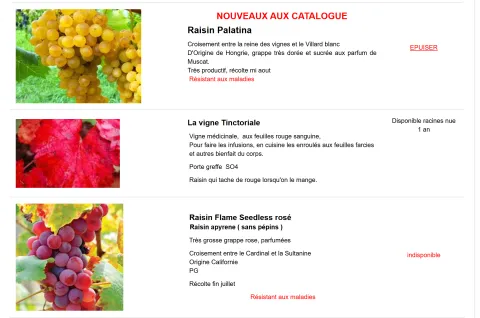
If you want to see where Alain's passion really flares up, look at the vine catalogue. He's a major proponent of "PIWI" varieties - grapes bred for natural disease resistance. We're talking about names like Floreal, Vidoc, and Artaban, which are modern marvels of viticulture that can stare down mildew without flinching.
But Alain also keeps the "outlaws" - the old French-American hybrids like Noah, Clinton, and Isabelle. These vines have a wild history; many were actually banned in 1934 by the French government, supposedly over concerns about methanol in the wine (though some say it was just protectionism). To this day, you can't legally use them for commercial wine production in the EU. Jabouin doesn't hide this; he flags it clearly: "Non autorise a la Revente en jardinerie." He sells them to individuals - the backyard hobbyists and the heritage seekers. It's less of a commercial nursery and more of a rogue gene bank with a price list.
A Catalogue of the Forgotten
Beyond the resistant vines, the Jabouin catalogue is a graveyard of varieties that the industrial world forgot. You'll find the Cornichon blanc (which looks exactly like a little pickle), the Barbaroux (a Provencal staple since the 1700s), and the Servant - the grape our grandparents used to hang in the attic to dry for Christmas treats.
Then there are the "hardy" newcomers from Ukraine and Eastern Europe, like Veles and Heliodore. These varieties are built for the brutal frosts that can roll off Mont Ventoux, surviving temperatures as low as -25 degrees C. Alain notes that Heliodore can produce seedless bunches weighing up to six kilograms. Whether or not you ever actually grow a grape bunch the size of a small dog, the ambition is admirable. One thing you'll notice on the website: many items are marked "EPUISER" (Sold Out). It's an honest reflection of a small farm - when it's gone, it's gone.
The Fig That Put Caromb on the Map
You can't talk about Jabouin without talking about the Figue Longue Noire de Caromb. This is the family's crown jewel. Henri Jabouin gave the variety its name back in the 50s, and Alain has spent his life championing it. He'll tell you the variety originally crossed over from Italy (where it's known as the Douqueira), but in the dry, chalky soil of Caromb, it found its true home.
These trees are survivors. They froze to the ground in the legendary winters of 1956 and 1985, only to sprout back from the roots. Today, the farm pulls in about ten tonnes of figs a year. Alain's dedication goes beyond the farm gate, too - he's the "Grand Master" of the Brotherhood of the Long Black Fig of Caromb. He's not just a grower; he's the variety's chief protector, ensuring that this local treasure has its own conservatory orchard and its own place in the history books.
Rooted in the Soil, Not the Office
At the end of the day, this is a working farm, not a boutique. Alain manages five hectares of table grapes and another hectare of wine grapes (the classics like Grenache and Cinsault), alongside his cherry and olive trees.
When you order from him, you follow the rhythm of the seasons. Shipping starts in December because, as Alain puts it, the plants need time to "build their reserves" before being lifted. It's the kind of practical wisdom you only get from someone who has spent their life with dirt under their fingernails. He doesn't lean on flashy organic certifications or marketing labels; he uses fermented nettle and horsetail preparations because that's what works. It's an operation built on three generations of trial, error, and a deep-seated refusal to let the old ways die out.