Summary
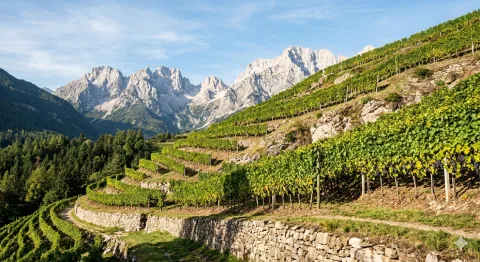
Cantina Sass Griss sits in Coredo, on the Altopiano della Predaia in Val di Non, Trentino — apple country, not wine country. Andrea Sicher and his son Nicola, a surveyor by training, founded it and brought in Nicola Biasi as consultant winemaker. The vineyards are above 900 metres on south-facing slopes — roughly two hectares, planted in 2020 with the PIWI varieties Solaris and Johanniter.
PIWI — pilzwiderstandsfähig in German — is the acronym for varieties bred to resist fungal disease, mainly downy mildew (Plasmopara viticola) and powdery mildew (Erysiphe necator). Two IGT Vigneti delle Dolomiti wines have come out of the project. Cryo — from the Greek for cold — is made from Solaris: pronounced aromatics, a balsamic nuance, picked in early September. Aura, named for the breeze, comes from Johanniter — fresher, easier to drink, and given about a year in the cellar before bottling.
Biasi is not new to Johanniter in this territory — his “Vin de la Neu” already has international recognition. Alongside the Sass Griss wines, the event presented “Le Alte del Pineta” — an organic Johanniter from Pineta Nature Resort, made with Biasi from high-altitude crus in the Alta Val di Non. Behind the Italian PIWI scene sits the Fondazione Edmund Mach, where Prof. Marco Stefanini heads the genetics department and chairs the Associazione PIWI Italia. No yield, price, or distribution data appears.
Our take
This is event coverage, not journalism. Every tasting note is positive, nothing is questioned, and the piece ends with “Chapeau! Prosit.” The factual base is also shaky. Esca is listed among diseases PIWI varieties resist, a claim no research literature supports — esca is a wood disease complex, and PIWI resistance does not extend there. The German institution responsible for PIWI development is misidentified as a university faculty; the Staatliches Weinbauinstitut Freiburg is an independent state body.
About the author
Giuseppe Casagrande writes for Italia a Tavola. There is almost nothing to evaluate critically here. No source is questioned, no claim tested. Superlatives accumulate from the first paragraph onwards. The piece also presents two people called Sicher — Andrea, founder of Sass Griss, and Andreas, co-owner of the Pineta Resort — without explaining whether they are the same person or related, an obvious question a more careful writer would have answered.
About the publisher
Italia a Tavola is a long-established Italian trade publication for the food service, hospitality, and wine industries. The readership is professional, the tone is supportive, and hard questions are rarely asked. This article is a fair sample of the house style: a product launch becomes a glowing report, tasting notes effusive, context thin.