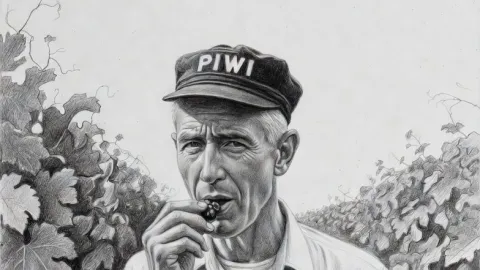
The man nobody talks about
Ask a hundred wine enthusiasts to name the people who shaped American viticulture and the same names come up. Robert Mondavi. Andre Tchelistcheff. Maybe Ernest Gallo if the person is feeling provocative. Philip M. Wagner almost never gets mentioned, and that bothers me more the longer I think about it.
Wagner did not work in Napa. He had no famous label, no chateau, no documentary. He lived in Baltimore, wrote editorials for a newspaper, and spent his evenings tending French hybrid grape vines in his garden. For a long stretch of the twentieth century he was among the most consequential figures in eastern American winemaking. Most wine drinkers have never heard of him. That is not a quirk of history. It is a choice that history keeps making, and it is the wrong one.
The newspaper man
Philip Marshall Wagner was born in New Haven, Connecticut, on February 22, 1904. Academic family, bookish household. He studied at Princeton, then Michigan, then found his way into journalism, which suited him well. He ended up at the Baltimore Sun, serving as chief editorial writer from 1943 to 1964 — a position of real influence at a paper that took itself seriously, in an era when regional newspapers still could.
The wine interest started during Prohibition, as it did for a lot of people: home fermentation, California juice grapes, improvised equipment. At some point he decided to grow his own vines. He planted European varieties behind the house — Vitis vinifera — and they died. Maryland summers are hot and wet. Maryland winters are cold enough to kill tender wood. Vitis vinifera, for all its nobility, is not built for that. He made a note of the failure, which was the journalist in him, and kept looking.
Kent, of all places
The answer came from an unlikely direction. Wagner was posted to London as a correspondent when he found his way to the East Malling agricultural research station in Kent. There he encountered French-American hybrid grape varieties for the first time — crosses that French breeders like Albert Seibel and others had been developing since the phylloxera crisis of the late nineteenth century forced a fundamental rethinking of what a grape vine needed to be.
The French establishment never warmed to hybrids. There was snobbery involved, and in parts of Europe they were restricted or outright banned from quality wine production. They were seen as a compromise rather than a genuine ambition. Wagner looked at them and reached a different conclusion. He saw varieties that could handle cold and damp, resist the fungal diseases that made Vitis vinifera so expensive to grow in humid climates, and still produce something that tasted like wine. He brought cuttings back to Baltimore.
Riderwood
Back home, Wagner propagated his French hybrids, kept notes, and wrote about what he found. When readers wrote to ask where they could get the same vines, he sent cuttings. There was no business plan. He had found something useful and saw no reason to be proprietary about it.
The requests kept coming. What had begun as informal correspondence eventually became Boordy Nursery — the name taken from Jocelyn Wagner's family background — which grew into one of the primary sources of French-American hybrid plant material in the United States. Growers in New York, Virginia, Pennsylvania, Ohio, and parts of Canada were ordering from a man who was simultaneously editing a daily newspaper. He also traveled to France and obtained cuttings of Vidal blanc directly from its breeder Jean-Louis Vidal, helping establish what would become one of the most important hybrid varieties grown in North America. How he managed all of this alongside a demanding full-time job is something his biographers, had he ever had proper ones, might have explored.
Wagner and his wife Jocelyn established Boordy as a bonded winery in 1930 — the first commercial winery in Maryland after Prohibition — and began producing wine commercially under the Boordy label in 1945. It was small. It was never going to appear on anyone's list of prestige estates. But it was not trying to. It was trying to prove that the eastern United States could produce wine worth drinking, and it did that consistently enough that people started paying attention.
The grapes
Wagner grew what worked and said plainly when something fell short. For whites he returned most often to Seyval blanc, bred by Bertille Seyve, which handled the mid-Atlantic climate better than almost anything and gave a clean, honest wine without demanding constant intervention. He also worked with Vidal blanc, Villard blanc, and Rayon d'Or.
On the red side: Baco noir, developed by François Baco, along with Chelois, Foch, and de Chaunac. Later Chambourcin became significant across the region. None of these are celebrated names. In certain wine circles they still provoke a mild wince, a slight raising of an eyebrow. That reaction says more about the circles than the grapes. Wagner understood what the varieties could not do, and said so. He also understood what they could do, in the right place and the right hands, and said that too. It is a harder position to hold than simple enthusiasm, and more useful.
The books
In 1933 he published American Wines and How to Make Them. No romance, no padding — just a practical manual for people who want to make wine rather than read about making wine. In 1945 he followed it with A Wine-Grower's Guide, which went through multiple revised editions over the following decades and became the standard reference for anyone establishing a vineyard east of the Rockies.
The writing is plain and specific. You can feel how much testing and failure and corrected thinking went into it. The section on site selection alone is worth more than most of what gets written about viticulture today. He also produced articles, bulletins, and a steady stream of correspondence that reached both amateur winemakers and professional growers. His influence on American home winemaking culture was deep and largely untracked, which is fitting in its own frustrating way.
What he actually changed
When Wagner started this work the conventional wisdom was simple: real wine came from California or Europe. The east was difficult. Native American varieties tasted wrong and Vitis vinifera couldn't survive. That view had enough truth in it to stick. It took someone willing to be patient and methodical and a little stubborn to push through it.
The Finger Lakes industry in New York, the early Virginia wine scene, small operations scattered across the mid-Atlantic and Midwest — many of these drew on plant material and accumulated knowledge that had come through Riderwood. Wagner was not the only person working in this space, but his contribution was foundational in ways that are still not fully named. There is something ironic about the fact that the man who spent decades answering letters from strangers, sending out cuttings, trying to share what he had learned as widely as possible, is also the man who never quite made it into the canonical version of the story.
After
He sold Boordy Vineyards to the Deford family in 1980. They moved it to Hydes, Maryland, where it still operates. Wagner kept writing and corresponding and remained involved in wine organizations including the American Wine Society. He died at home in Riderwood on December 29, 1996. He was 92.
The obituaries were respectful and accurate and, given what he had actually done, somewhat underweight. That is not unusual for people whose work was diffuse and cumulative and expressed mostly through correspondence and plant cuttings and a good practical book. History likes a single decisive moment. Wagner's career was mostly not that.
Boordy Vineyards is still there. Seyval blanc is still grown across the eastern United States. His books still turn up secondhand. Somewhere there is almost certainly a small vineyard in Maryland or Virginia or upstate New York that started because someone tracked down a vine from Riderwood and worked out the rest from his pages. He probably answered that person's letter himself.