A Living Archive in Dangolsheim
Vincent Zerr keeps somewhere between 500 and 600 grape varieties in Dangolsheim, a wine village on the Alsace Route des Vins twenty-five kilometres west of Strasbourg. Around fifty of those are in active multiplication and available to buy. The rest grow, get observed, get tasted, and occasionally get taught. The nursery markets itself as a conservatoire vivant de vignes — a living vine conservatory — to distinguish it from purely commercial operations, and that description holds. It is maintained not by a research station or an agricultural ministry, but by one family in a small plot within their larger farm off the Chemin des Aulnes.
Vincent Zerr, born in 1965 according to the Bio Grand Est interview, grew up the son of mixed-crop farmers who made a little wine for the local cooperative. He trained at the agricultural school of Rouffach, and according to the same interview went on to study at the viticultural school of Avize in Champagne, though this second school does not appear in all published profiles and cannot be independently confirmed. He started collecting grape varieties around 1983, bringing plants back from practical placements including a stint at the experimental station of Tresserre. He set himself up as a vine nurseryman in Dangolsheim in 1987, though the official EARL registration date is later and the distinction between his personal activity and the formal legal entity is not made clear in available sources. Two years after arriving in Dangolsheim he met Dominique, who became his wife and partner, and together they formally gave the nursery its name. The commercial name is Pépinière des Boarmies; the registered legal entity name and its precise spelling vary across sources and have not been definitively confirmed in the course of this research. Dominique built the website herself after a computing course at the CFPPA in Obernai; it has been online since 2007, written in plain language aimed at people who do not already know what they are looking for.
Resistant Grape Varieties
The nursery's whole logic is built around one geographical fact: Alsace is not the south of France. Varieties that thrive around Montpellier or Bordeaux either fail here or demand a level of chemical intervention that Zerr is not interested in. So the catalogue is stacked with varieties bred for cold winters and wet summers — mostly hybrids from Eastern Europe, Germany, Hungary, and Canada, chosen because they carry genuine resistance to downy and powdery mildew and can tolerate severe winter frosts better than many ungrafted Vitis vinifera plantings in this climate.
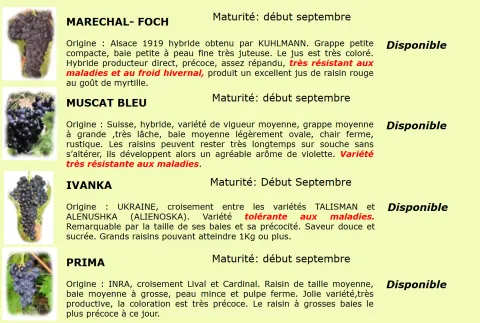
The varieties Zerr flags explicitly as disease-resistant run across all three colour categories in the catalogue. On the black side, Muscat Bleu from Switzerland is described as very resistant; Maréchal Foch, the 1919 Kuhlmann hybrid born in Alsace itself, is very resistant to both disease and cold — though it is primarily a wine grape rather than a table variety, and appears in the catalogue for its ornamental and polyvalent qualities; Baco Noir, François Baco's 1902 cross of Folle Blanche with Vitis riparia, is similarly a red wine grape included for its exceptional hardiness. Among the whites, Palatina from Hungary is resistant and aromatic with a muscat character; its precise parentage is cited differently across sources — the Boarmies catalogue gives Seyve Villard 12-375 crossed with Reine des Vignes, while other viticultural references describe a more complex Hungarian lineage — and no single authoritative version can be confirmed here. Phoenix from Germany is resistant; Calastra, sometimes attributed to Germany and sometimes to Swiss breeding programmes, is described as very resistant and vigorous enough to cover a pergola on its own. On the pink side, Wiktoria — listed in the catalogue as Russian in origin, though other sources credit Ukraine — handles disease and severe winter frost; Lidi from Hungary is resistant and easy to grow; Nizina specifically resists downy mildew while tolerating powdery mildew. These are not varieties chosen for prestige or appellation eligibility. They are chosen because they work where most of the wine world's favourite grapes struggle. The full list across the three catalogue pages runs to more than twenty explicitly flagged resistant varieties, with further options available off-catalogue on request.
The Collection Nobody Commissioned
The hundreds of varieties in Dangolsheim did not accumulate because a grant was awarded or a research programme was launched. They came the way obsessions come — variety by variety, contact by contact, over four decades. The France 3 regional television report from September 2024 puts the figure at between 500 and 600; the 2021 Bio Grand Est interview says 600. Zerr is the source for both, and no independent audit has been found. The collection is real enough to have attracted visitors from far beyond Alsace. A 2015 blog account of a visit to Dangolsheim describes Zerr pulling out varieties not even listed on his own website, apparently navigating the collection from memory. The same account says he has advised on vineyard creation in the Republic of Congo; this cannot be verified from the Boarmies site or from other primary sources and should be treated accordingly.
What the site does make clear is that ripening dates in the catalogue are calibrated to the Alsatian climate specifically, because data from warmer regions is simply wrong when you move it this far north. That local calibration is one of the things that makes the catalogue genuinely useful rather than just impressively long.
Sold in Pots, One Plant at a Time
The nursery does not do wholesale and does not do bulk. Plants go out in individual pots. The website states that sales are exclusively to private individuals, though the Bio Grand Est interview lists both private individuals and professionals among the buyers. This discrepancy has not been explained publicly and may reflect a change in policy over time, or a distinction between formal retail and occasional local professional sales. Either way, the target has always been the gardener, the collector, the amateur who wants something unusual on the pergola, the organic market gardener looking for a table grape that does not need spraying every ten days. Visits to the collection are possible by appointment during harvest season, with an open day in early September and group visits available from late August through mid-October. Whether plants are sold grafted or ungrafted, and which rootstocks are used, is not specified on the website, and no information on phytosanitary certification or plant passport compliance has been found in the sources consulted.
A Nursery Inside a Farm
The nursery plot sits inside a much larger operation. Les Jardins de la Marmotte, the family farm at Dangolsheim, covers sixteen hectares in total: AOC vines, table grape parcels, cereal fields, vegetables, apricot orchards. The nursery collection itself occupies a small portion of that — the Bio Grand Est interview gives a figure of two ares, though Vincent Zerr has also cited approximately 250 square metres in other contexts, a modest difference that likely reflects how the boundaries of the active collection are defined at any given time. Dominique manages the shop and the website; Vincent is in the parcels. Their sons are part of the picture — one trained as a baker and makes bread from heritage wheat varieties the family started growing in 2012, another works as an apprentice on the farm.
Teaching has grown into something real. There are public courses on vine cultivation — the current website lists a spring session on planting, bud removal, tying, grafting and propagation — and more structured professional training developed with the CFPPA in Obernai and Bio Grand Est. The Bio Grand Est interview describes a twelve half-day programme for organic market gardeners in the Grand Est region, spread across the key moments of the vine's annual cycle, conducted entirely outdoors, though more recent sources suggest the programme format may have been adjusted since. For a small family nursery, that is a serious educational commitment. Zerr did not design it that way from the start. It just kept being what people needed.