Summary
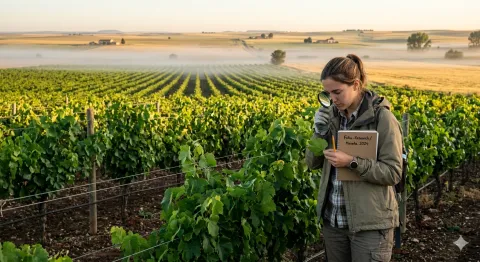
Seven years. That's how long it takes to run four PIWI varieties — fungus-resistant grapes bred mainly in Central Europe through classical interspecific crossing — through trials on a Spanish research estate and get them onto the national register. Researcher Enrique Barajas at Itacyl, working with nursery group Agromillora, planted nine candidates at Finca Zamadueñas near Valladolid in 2018. With woody crops you wait. The first data worth anything didn't arrive until 2022. By 2025 the documentation was done, the Junta de Castilla y León had approved it, and the ministry signed off on distinctness, homogeneity, and stability. The four that made it — whites Soreli and Sauvignac Rytos, reds Cabernet Eidos and Merlot Khorus — were already fully developed and commercially registered in Italy by the University of Udine and VCR. Spain was evaluating proven material, which is a very different thing from developing it, and worth saying plainly.
What Barajas actually wants, though, is a resistant Garnacha and a resistant Godello. Not Italian hybrids doing a reasonable impression of something Spanish, but new varieties produced by crossing those native grapes with resistant donors — same name, same general character, different parentage, built to handle disease without a fungicide programme. Both have been grafted onto established vines rather than planted from scratch, which should shave some time off the evaluation clock, though how much depends on how the trials go. The 2031 target is plausible. DO Bierzo is floated as a natural home for a resistant Godello, which makes geographic sense, though no one in Bierzo appears to have been asked. Meanwhile DO Rueda had been moving toward including these varieties before the Junta suspended something — the article is vague on what exactly — in October 2024. One sentence. For what is genuinely the most telling detail in the piece.
Our take
The science here is real and Barajas has clearly put in the years. No argument there. What grates is that this reads less like journalism and more like a lab visit where nobody asked an awkward question. One source, no pushback, no grower who tried these varieties and found them difficult to sell, no DO official explaining why the adoption process moves so slowly. The Rueda suspension is the most revealing thing in the piece — it shows exactly how quickly political hesitation can swallow agronomic progress — and it gets brushed past in a subordinate clause. If you want to know whether resistant varieties will actually change Spanish viticulture, this article won't tell you. It'll tell you the research is going well. Which it is. But that's not the whole story.
About the author
Ricardo Ortega covers viticulture and agricultural innovation for Revista Campo and handles the technical material competently — he doesn't get lost in the registration process or the timeline. But across his bylines on this subject, the sourcing never really changes: one researcher, institutional framing, no friction. Maybe that's what the publication wants. Maybe it's just how he works. Either way the result is coverage that informs without ever quite challenging anything.
About the publisher
Revista Campo is Grupo Campo Comunicación's main title — an agricultural trade publication based near Valladolid covering everything from cereals to vine management. It co-organises field demonstration events with Agromillora, the nursery group at the centre of this article. That relationship goes unmentioned in the piece. It doesn't automatically make the coverage wrong, but readers following this story regularly should probably know it.