Copper in the Soil Is Making PIWI Hard to Ignore

Image
Wie «Piwis» für mehr Bio im Rebberg sorgen
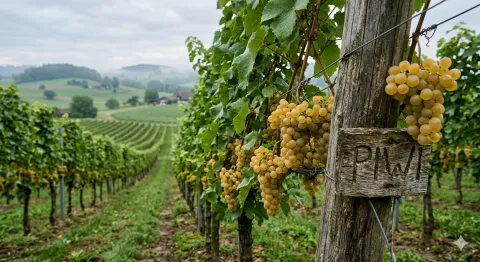
Solaris grapes in morning light.
Article title
Wie «Piwis» für mehr Bio im Rebberg sorgen
Link to article
Date of publication
Publisher
Bilanz
Author
Ursula Geiger

Summary

The article starts with a practical problem that is hard to argue with: copper builds up in vineyard soil and hurts the organisms organic growers are trying to protect. Replacement sprays are being tested but they are not ready yet, and even if they were, you still need to drive a tractor through the vineyard every time you spray, which compacts the soil. That is the opposite of what organic viticulture wants. So growers are planting resistant varieties instead.

The numbers are still small but the trend is clear. Switzerland had 519 hectares of PIWIs in 2023. Lucerne is at 30 percent. Austria leads the DACH region with 25 percent organic share, followed by Switzerland at 20 and Germany at 15. White favorites are Souvignier gris, Solaris, and Muscaris. Reds are Divico, Cabernet Jura, and Regent. The breeding work takes years because crossing Vitis vinifera with resistant wild species gives you hundreds of seedlings with random combinations of traits, and most of them are not good enough.

The article also admits PIWIs have an image problem. The wines taste different and winemakers need to learn new techniques. Blind tastings help. The Gen Z section at the end is the weakest part—it makes a claim about young drinkers not caring about critic scores that sounds nice but has no real support.

Our take

I buy the copper argument and it is the best framing I have seen for why PIWIs matter right now. But the article draws a line that is too clean: copper is bad, PIWIs are good, done. In reality, many organic growers already use copper at reduced rates and manage fine. That middle ground is missing. The Gen Z stuff feels like filler. I would have traded it for a paragraph on how different countries regulate PIWIs in appellations, because that is where the actual friction is.

About the author

Ursula Geiger trained as a winemaker and studied at Geisenheim before becoming a journalist at Bilanz. That is an unusual and good background for wine writing. You can feel it in the article when she talks about tannin structure and how hard it is for winemakers to learn new techniques for PIWIs. That is not something a pure journalist would think to include. The Gen Z section reads like someone else's edit, not hers.

About the publisher

Bilanz is a Swiss business magazine. Rich people read it. This piece ran in the "enjoy" lifestyle section alongside travel and watch articles. So the framing makes sense—it is a clean, readable story aimed at people who drink good wine but do not work in the industry. Technical depth is traded for accessibility. That is fine for what it is, but you should not come here for detail on resistance genetics or appellation law.