Image
Country of origin
Hungary
Variety number VIVC
550
Prime name (VIVC)
Aranka
What is the origin?
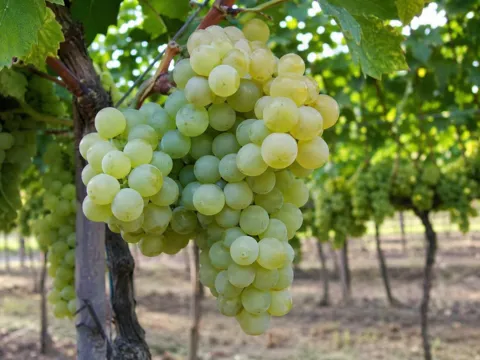
The VIVC entry for Aranka — number 550 — records a white grape of Hungarian origin and nothing further worth reporting. No parentage. No breeder. No date. No plant variety protection. Whether this is an ancient landrace, a chance seedling someone found useful for a generation or two, or a variety that existed mostly as a label in old records is impossible to say. Grape records from Central and Eastern European regions often remain in regional archives and local ampelographic literature that has never been digitised, so apparent obscurity and actual obscurity are not always the same thing.The synonyms scatter across what used to be a single cultural region before the twentieth century turned it into several countries. Goldtraube is simply "golden grape" in German, the obvious name for a pale-berried vine in the multilingual Carpathian Basin. The multilingual synonym set hints at wider historical presence, though synonym spread can come just as easily from nursery catalogues, migrating cuttings, or the habit of giving things new names in a new language.
The Serbian Zlata complicates matters while also, slightly, making sense of them. Its breeders — Petar Cindrić, Lj. Jazic, N. Ruzic and N. Vukmirovic, working at Sremski Karlovci in 1976 — crossed Irsai Olivér with Kunleány, a Hungarian interspecific hybrid carrying Vitis amurensis blood, which is where the frost tolerance comes from. They named it Zlata. The synonym Aranka followed because that is what Zlata means in Hungarian. Whether the two VIVC entries are tracking the same vine or two vines with rhyming names is a question that has not been asked formally, let alone answered.
What is the distribution, regulatory status and market development?
The 2016 Kym Anderson global vineyard statistics recorded no commercial plantings of Aranka, and nothing has surfaced since. It does not appear in the national variety registers consulted, though absence from a commercial register is not the same as extinction — gene banks and private collections are a different matter entirely.The Julius Kühn Institute holds photographs of it — clusters, leaves, the full ampelographic documentation — which means someone has had the plant in front of them, probably at Geilweilerhof, where historical varieties from across Central Europe are maintained. The VIVC entry also records morphological data: berry shape, leaf characteristics, enough to allow identification in the field if anyone needed to do that. Not commercially grown, but not gone.