Image
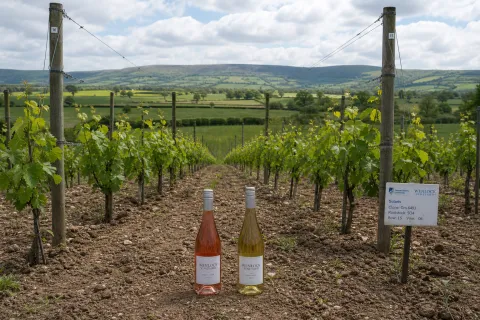
First wines from a teaching vineyard.
Article title
First wines from Harper Adams University's vineyard to be launched this week
Link to article
Date of publication
Publisher
Harper Adams
Summary
In 2023, Harper Adams University planted a vineyard on its estate in Edgmond, Shropshire, and it has now produced its first two commercial wines. A year and a half is fast in viticultural terms—most vines don’t give you anything worth harvesting until year three or four—and the university doesn’t dress it up: what came off in autumn 2024 was a small symbolic picking, not a commercial crop. Every variety on site contributed something; it all went into the 2024 Buttery Hill Rosé. By 2025 there was enough fruit for three separate batches. The first, a still dry white called the Cambrian White, is now in bottle, from the 2025 vintage. The other two have not been named. Buried a little further down is the fact that the wines are commercially produced and bottled at Halfpenny Green Wine Estate—it gets a mention in the article, and not much more.Professor Frank Vriesekoop, who runs the project through the university’s Harper Food Innovation department, is refreshingly honest about what the vineyard is really for. It’s a classroom first, a laboratory second, and a winery third. The wine, he says, mainly just covers the bills. The planting includes four PIWI varieties—Muscaris, Divico, Solaris, and Cabaret Noir—alongside Bacchus, Chardonnay, Pinot Noir, Siegerrebe, and Müller-Thurgau. For anyone reading this on a PIWI-focused site, that detail matters, and the article gives it very little room. The launch event at Shrewsbury Museum was reportedly sold out. Two Harper Adams alumni appeared on the producer panel: Zoe Evans of Rowton Vineyard, and Clive Vickers of Halfpenny Green, whose late father Martin founded that estate and then came back decades later to help plant the Harper Adams vineyard. England and Wales now have well over a thousand registered vineyards, and Harper Adams has its eye on training whoever ends up running them.
Our take
Let’s be direct: this is a university press release, and a fairly well-written one. It is not journalism. Nobody asked the professor whether the Cambrian White had been tasted by anyone outside the building, or what the spray programme looks like for the PIWI blocks, or whether Divico, Solaris, and Muscaris are performing as hoped in a Shropshire winter. Those are the questions a trade reporter would ask. Instead we get quotes, warm context about alumni networks, and a description of the wine as “an extremely pleasant dry-white”—from the man who made it. That may be entirely true. It’s just not evidence.For readers who want to understand what growing disease-resistant varieties in the West Midlands actually looks like in practice, this article is a starting point, not an answer. The other two 2025 batches are still unnamed, and nobody has explained why.