Image
Country of origin
Romania
Variety number VIVC
23539
Prime name (VIVC)
Andrevit
Year of crossing 1)
1974
What is the origin?
The VIVC entry for Andrevit gives you this: crossed in 1974, selected in 1980, released in 1994, country of origin Romania, breeders Oprea, St. and Olaru, B., institutional address the Fruit Growing Research Station in Cluj-Napoca. A fruit station. Not a viticulture institute, not a wine research centre. During the communist period that distinction apparently mattered less than it sounds — Romanian horticultural research stations routinely bred grapevines alongside their apple and pear work, and table grapes counted as practical food production. Oprea produced nine grape varieties at that station: Timpuriu de Cluj, Napoca, Someșana, Transilvania, Splendid, Andrevit, Admira, Vlad, and Cetățuia. He worked vines for decades under a fruit-station title, and the world outside Romania noticed none of them.Cluj-Napoca sits in Transylvania. The broader region has a real winemaking history — Târnave, Alba, Aiud all within reach — but Cluj itself is not where Romania’s wine reputation was built. That a fruit station there ended up with a grape breeding programme is not strange in context; it is simply what communist-era research infrastructure looked like, distributed across the country and assigned to whatever institution could house it.
Parent one is Seyve Villard 23-18, a white-berried French grape from the Seyve-Villard programme at Saint-Vallier, the joint work of Bertille Seyve and his father-in-law Victor Villard. The precise pedigree of SV 23-18 — sometimes cited as Rubilande crossed with Chancellor — is difficult to verify from primary sources; many Seyve-Villard numbered hybrids lack standardised public records at that level of detail. What is not in doubt is the colour: the variety is white, so Andrevit’s white berries require no special explanation. Two white parents, white offspring.
Parent two is Koenigin der Weingaerten — Queen of the Vineyards in German, Regina Viilor in Romanian — a Hungarian Vitis vinifera muscat variety associated with the work of János Mathiász. DNA analysis at some point corrected the historical pedigree: confirmed parentage is Afus Ali crossed with Csaba Gyöngye, not what the original breeding documentation stated. It carries numerous synonyms across languages, still sits in the European Catalogue, and its muscat aromatic character was the obvious attraction for anyone designing a flavourful table grape. Disease tolerance from the Seyve-Villard side, muscat elegance from the Hungarian vinifera — that was the brief.
Romanian sources give more data than the VIVC does. Sugar at 170 g/l, yields up to 20 t/ha, September ripening, mixed-use classification covering both table and wine production. The VIVC entry records none of this — no SSR marker confirmation, no resistance loci, no plant variety protection, no holding institutions, no registered area. The taste field reads: none, which in the VIVC system is a default placeholder for unclassified varieties and not a verdict on what the grape actually tastes like.
How does it adapt to climate and what is its ripening profile?
The Cluj-Napoca region has cold winters and warm summers. Whether Andrevit’s North American species heritage translated into useful frost hardiness was apparently never published anywhere accessible.How does it grow in the vineyard?
The VIVC lists no holding institution. The Romanian Ministry of Agriculture’s guide for virus-free propagation material lists Andrevit as maintained at S.C.H. Cluj Napoca, alongside Admira and Vlad. Eastern European breeding collections have historically been invisible to international databases — not because the material does not exist, but because voluntary reporting systems favour institutions with the infrastructure and incentive to report. Andrevit is probably still in the ground somewhere, in a row of a research plot that nobody has photographed for a database entry.How does the wine taste?
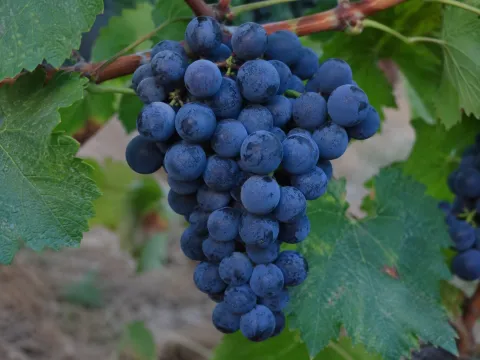
The VIVC records taste as none, the default for unclassified varieties. Romanian sources describe green-yellow berries, semi-crisp flesh, a sweet-sour balance without pronounced aroma. Muscat character can wash out entirely in a cross, and apparently did here. Nothing in the Romanian descriptions suggests the American species side introduced off-flavours, which is not guaranteed with Seibel-lineage parents. Someone classified this as a table variety and published productivity figures for it.What is the distribution, regulatory status and market development?
Not in the European Common Catalogue. No registered area in the VIVC country tables. Andrevit was officially released in Romania in 1994, twenty years after the crossing — standard timing for Eastern European testing and multiplication cycles. It appears in Romanian agricultural ministry documentation as a propagated variety. No nursery offers it in any international catalogue that can be found.Which estates and wines stand out?
There isn’t one.What is the future outlook?
The SCH Cluj Napoca material may still be in the ground. The Ministry of Agriculture listed it as actively propagated there; whether that documentation is current, or reflects a state of affairs that ended sometime in the 1990s when institutional priorities shifted, nobody outside the station can say. Andrevit was selected nine years before 1989. A lot of communist-era breeding work did not survive that transition intact.As a breeding exercise the 1974 cross had coherent logic: Seyve-Villard disease tolerance plus Hungarian muscat elegance, designed for Transylvanian growing conditions. The fact that it reached official release in 1994 rather than dying in a trial block suggests it passed whatever internal evaluation the station applied. It never went further than that. Andrevit is a VIVC entry number and a question whose answer probably exists on a research station in Cluj-Napoca, filed under a Romanian name and not digitised in any language the rest of the world reads.