What is the origin?
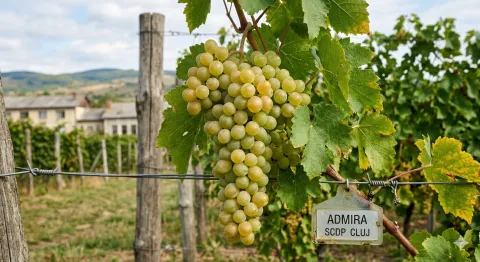
Admira came out of a fruit station. The Stațiunea de Cercetare-Dezvoltare pentru Pomicultură Cluj-Napoca in Cluj — pomicultură means fruit growing, and that is what the institution was primarily for — carried grapevines alongside the main apple work. Several grape varieties came out of it. None of them went anywhere commercially. That is probably not a coincidence.
The breeders of record in the Vitis International Variety Catalogue are Oprea, Șt. and Olaru, B. Ștefan Oprea was born in 1928 in the wine village of Valea Călugărească, Prahova county — which means the man responsible for Admira grew up in one of Romania's most celebrated vineyard landscapes, then spent the bulk of his professional life, 1954 to 1994, at a fruit station in Transylvania. He held professorial roles in viticulture at the Agricultural Institute of Cluj-Napoca and sat on the OIV experts group on grapevine genetics and breeding. He died in 2013.
B. Olaru — Bănică Olaru — is documented as a researcher at SCDP Cluj-Napoca with co-authored work from the period, though little biographical detail has been published.
The cross is Villard Noir (SV 18-315) × Csaba Gyöngye. Villard Noir is a French-American hybrid from the Seyve-Villard breeding house, built on Seibel lines — including Chancellor (Seibel 7053) and Subereux (Seibel 6905) — with North American Vitis blood throughout. Dark-berried. The white colour Admira carries most likely came from the other side of the cross.
That other side is Csaba Gyöngye — Pearl of Csaba, Perla de Csaba in Romanian — a pure Vitis vinifera white table grape bred in Hungary in 1904 by Adolf Stark, reportedly from Madeleine Angevine and Muscat de Courtillier, also known as Muscat Fleur d'Oranger. Fresh-eating variety, early ripening, a little musky, susceptible to powdery mildew. Romanian regulation calls Admira a first-generation interspecific hybrid, though Villard Noir already carries several generations of hybrid breeding behind it — the resistance depth that modern PIWI varieties build over successive backcrosses was never part of this picture.
The VIVC logs no year of crossing, selection, or variety protection. The pedigree has not been verified by SSR markers — no genetic data of any kind exists for this variety. A synonym, Admiralt, turns up in at least one database. No plant breeders' rights are on file. The name Admira has no documented etymology.
What is it resistant to?
Search for Admira in the resistance literature and you find nothing. No Rpv locus, no Ren locus, no trial data of any kind.
So you look to the parents. Villard Noir is highly resistant to downy mildew (Plasmopara viticola), a product of the American Vitis blood in the Seibel lines — it performs well against this disease in practical field conditions. Against powdery mildew (Erysiphe necator) it is susceptible, and Csaba Gyöngye is equally susceptible, so there is nothing on either side of the cross to compensate. Romanian field descriptions do report good tolerance of Botrytis cinerea, which would make sense for a variety developed in the humid conditions of Transylvania — it is one of the more concrete claims anyone has made about Admira.
Romanian sources place it in the "soiuri rezistente" category — resistant varieties — specifically as a "hibrid inobilat, soi artizanal," an ennobled hybrid artisanal variety. A regulatory designation, not a resistance rating. The category covers first-generation interspecific crosses permitted for wine and table production, as distinct from the older direct-producer hybrids still restricted across the EU. Which disease it resists, at what level, under what spray programme — the record does not say.
How does it adapt to climate and what is its ripening profile?
Admira ripens in Epoch V of the Romanian phenological calendar: the second half of September, 16th to 30th. Well after its parent Csaba Gyöngye, which can be table-ready in July. The late-ripening character came from the Villard Noir side. Romanian breeding records do give one hard number: frost hardiness down to -24°C, and in a region that gets serious winters that is worth knowing. Beyond that the record goes blank — no Huglin index, no Winkler index, no phenological data beyond the ripening epoch. It was developed in Transylvania. Continental climate. That is the full extent of what can be said.
How does it grow in the vineyard?
The yield ceiling is high: 19 tonnes per hectare, with average cluster weight around 210 grams. That is table grape sizing. Wine programmes usually want half of that. Both figures point the same direction. Beyond the numbers, the agronomic picture is essentially blank — no soil data, no rootstock guidance, nothing on pruning or vigour or coulure risk. Approved for production. Not documented for it.
How does the wine taste?
The berry has greenish-yellow skin and firm, semi-crunchy pulp — "tare" in Romanian, meaning hard, a word borrowed from fresh-fruit evaluation rather than winemaking. Sugar at harvest runs to 170 grams per litre, around 10 per cent potential alcohol. Drinkable. Not interesting.
The aroma descriptor is "gust/aroma franc, fara aroma" — frank taste, no specific aroma. Csaba Gyöngye carries muscat character from its Muscat de Courtillier ancestry, but aromatic traits do not transfer reliably in first crosses and can behave recessively or unpredictably. The aroma was bred out, or it never came through. What is left is a neutral berry with nothing to say. No acidity data, no pH, no fermentation trial results have been published anywhere.
What is the distribution, regulatory status and market development?
Admira is officially approved — "omologat" — for commercial production in Romania, listed as an interspecific crossing for table and wine use. Romanian records suggest homologation sometime in the first half of the 1990s; the precise year varies by source.
Outside Romania it barely registers. Absent from the EU Common Catalogue of Agricultural Plant Species. Listed in few national wine grape registers beyond Romania's own. It does appear in the European Vitis Database. No AOP or PDO anywhere has documented it as a permitted variety.
As for actual planting: Romanian records put attested cultivation at approximately 0.03 hectares as of 2021. The "commercial production" on its registration is largely a formal courtesy. No nursery catalogue, no wine list, no grower report places it in active production beyond amateur and horticultural circles.
Market presence
The following figures are generated by our PIWI bot, which identifies nurseries, estates and their wines made from this grape variety.
Which estates and wines stand out?
Nothing. No commercial wine bearing the name exists in any record — no winemaker, no estate, no competition entry. Whatever Admira does in a fermentation tank remains unknown, because the question has apparently not been worth asking.
What is the future outlook?
Romania's PIWI development trail runs cold faster than most. The varieties bred at agricultural stations during the communist era were designed for a different wine economy — one that valued yield, dual-use practicality, and regional self-sufficiency over documented resistance loci and aromatic complexity. Most of those varieties never generated the scientific or commercial follow-up that would make them legible to the contemporary PIWI market. Admira is one of them.
The gaps in its documentation are not recoverable through inference. No resistance loci, no wine trial data, no planting statistics worth the name, no export record. In a European wine trade that increasingly demands traceability of exactly these parameters, Admira cannot compete with varieties that carry published Rpv loci, certified clone lists, and trial data from multiple independent institutes. It does not have a bad resistance profile. It has no published resistance profile at all, which is worse.
If climate change opens the higher elevations of Transylvania and the Mureș valley to serious viticulture, a late-ripening white interspecific hybrid with documented frost hardiness might find a footing. That is the optimistic case. The realistic case is that any grower in that position will reach for a variety with a documented resistance package and a functioning nursery supply chain. Admira is neither of those things today.