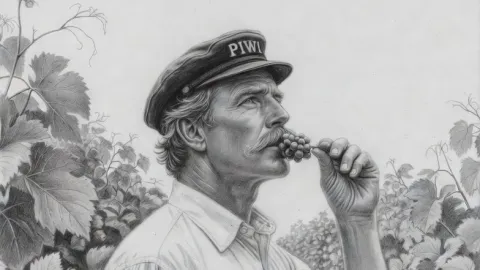
A Swiss apprentice in the Ozark hills
Hermann Jaeger was born on March 23, 1841, in Brugg, Switzerland, the sixth child of Karl Albrecht Jäger and Rosina Weibel. His father was a farmer and merchant. Family connections to the educational reformer Johann Heinrich Pestalozzi are often mentioned, though modern accounts suggest a more distant and complex kinship than earlier claims of direct descent. Jaeger was schooled in Switzerland until the age of sixteen, then served three years as a dry-goods apprentice from 1860 to 1863, followed by a year working at a wine business near Lake Geneva. That final experience gave him his first sustained exposure to viticulture. In 1864 he emigrated to the United States, landing in Norfolk, Virginia, before making his way west to St. Louis and then south into the Ozarks.
In 1865 Jaeger settled on a forty-acre farm near Neosho, in Newton County, Missouri, in the small community of Monark Springs. His brother John soon joined him, and the two combined their holdings. Jaeger planted his first vines in 1866 using cuttings brought from the eastern United States, including Concord and other varieties. Those imports carried downy mildew, threatening the young vineyard before it produced a crop. His response to that problem shaped the direction of his work.
An early experimenter in disease control
Faced with downy mildew, Jaeger developed a spray mixture of sulfur, iron sulfate, and copper sulfate, applying it directly to his vines. Contemporary local records indicate that the treatment was effective. While similar chemical approaches were being explored elsewhere — most notably in Europe, where Bordeaux mixture would be formalized in the 1880s — Jaeger’s work represents an early and largely independent example of chemical disease control in American viticulture. He did not publish a formal scientific account, and knowledge of his methods survives mainly through local histories and later reconstructions.
Reading the wilderness, building the arsenal
After stabilizing his vineyard, Jaeger turned to the surrounding landscape. The Ozarks host a wide range of native Vitis species, many of which possess natural resistance to pests and diseases that afflict European Vitis vinifera. Jaeger spent years identifying, transplanting, and evaluating these wild vines — often called “possum grapes” — selecting only a handful from many thousands for further work. His principal material included Vitis rupestris and Vitis lincecumii, both valued for their resilience.
His methods were empirical. He relied on observation, selection, and exchange rather than formal theory, corresponding with other figures such as Thomas Volney Munson and George Husmann. These networks of growers and experimenters across Missouri and Texas collectively built a body of practical knowledge that would later prove crucial. Jaeger is credited with developing or selecting more than one hundred grape varieties, though no complete catalog survives.
A collaborative response to a continental crisis
By the late nineteenth century, European vineyards were in crisis. Phylloxera, a root-feeding aphid introduced from North America, had devastated millions of hectares of vines and caused severe economic disruption. The eventual solution — grafting European varieties onto resistant American rootstocks — emerged through the combined efforts of growers, scientists, and officials on both sides of the Atlantic.
In 1887, French viticulture professor Pierre Viala traveled to the United States to identify suitable rootstocks, particularly for limestone-rich soils such as those in the Cognac region, where some American species struggled. He visited Jaeger’s farm as well as other key sites, including those associated with Munson and Husmann. Husmann played an important coordinating role in Missouri, helping connect French investigators with local growers and directing attention to promising native material.
Jaeger and his associates supplied significant quantities of rootstock to France; local accounts describe shipments totaling seventeen boxcar loads, though this figure is difficult to confirm in surviving French records and is best treated as approximate. His material was valued especially for performance in challenging soils, but it formed part of a broader system of American-derived rootstocks sourced from multiple regions.
Recognition, and its uncertainties
Jaeger was likely honored by France for his contributions to viticulture, with several sources indicating that he received a high agricultural distinction and possibly the Légion d'honneur. However, documentation is inconsistent, and details such as the exact year and form of the award vary across accounts. It is clear that both Jaeger and Munson were recognized by French authorities, though not necessarily as part of a single, formally defined group.
Monuments in France commemorate the role of American vines and growers in overcoming phylloxera, but they generally honor the collective contribution rather than any single individual. Jaeger’s role, while significant, was one among several in a wide-ranging international effort.
At the same time, his local circumstances deteriorated. Newton County voted to prohibit alcohol sales in 1887, undermining the economic basis of his vineyard. The contrast between international recognition and local restriction marked a difficult period in his life.
The science catches up, 130 years late
Jaeger worked before the formal development of genetics, and the full significance of his selections was not understood until much later. In 2012, a genetic study traced resistance traits in grapevines, focusing on the Rpv3 locus associated with downy mildew resistance in Vitis. The study identified several founding lineages contributing to modern resistance breeding, among which the vine known as Jaeger 70 was an important example.
Jaeger 70, later associated with Munson’s naming system, appears to have originated as a selected wild vine — likely derived from Vitis lincecumii — rather than a documented controlled hybrid. Its genetic contribution has been propagated through breeding programs and appears in a range of modern cultivars, though it represents one of several important sources rather than a single dominant foundation. As viticulture adapts to pressures to reduce fungicide use, such resistance traits remain central to ongoing breeding work.
Two marriages, five children, a school trustee
In 1872 Jaeger married Eliza Wagenrieder of St. Louis. She died the following year at nineteen, shortly after the birth of their daughter, Bertha. In 1874 he married Elise Grosse, also of St. Louis, and they had four children: Herman, Lena, Emma, and Carl. Jaeger served as a trustee of the local school, reflecting the community’s emphasis on education.
A later newspaper account describes a young George Washington Carver observing Jaeger’s work, but this story is based on secondhand reporting and remains unverified, and is best regarded as local tradition rather than established fact.
Prohibition, pressure, and disappearance
Jaeger’s final years were marked by financial strain, legal disputes, and declining health. The prohibition laws in Newton County severely restricted his business. In 1895 he announced plans to relocate his vineyard operations near Joplin.
On May 16, 1895, he left his family, stating he was traveling to Neosho on business. He did not return. Days later, his wife received a letter postmarked Kansas City, ending with the phrase “Your unlucky Herman.” Contemporary reports mention that a body found in Kansas City may have been his, but it could not be conclusively identified. Other explanations — including accident, suicide, or departure elsewhere — remain speculative. His fate was never definitively established.
Memory, institutions, and a living vine
Recognition of Jaeger’s work in Missouri has grown over time. A permanent gallery at the Springfield Discovery Center, established as a long-term installation in 2024, presents his contributions alongside modern genetic research. The exhibit includes a living vine descended from his selections, linking nineteenth-century fieldwork with contemporary science.
Physical traces of his life are limited. His original farmhouse was lost decades ago, and a later structure associated with the Jaeger family — likely belonging to his brother — was demolished in 2022. A historical marker in Neosho commemorates his work, though much of his legacy persists more in plant genetics than in surviving buildings.
A man who left a light paper trail
Despite his lasting influence, Jaeger left relatively little formal documentation. He published no major treatise and rarely appeared at scientific meetings. What remains is a scattered record: letters, journal contributions, and local accounts. His story has been reconstructed from these fragments, alongside later historical and genetic research.
His work illustrates how practical knowledge, developed outside formal institutions, contributed to one of the most significant agricultural recoveries of the nineteenth century.