A engineer's son from the Ardèche
Albert Seibel was born on 1 April 1844 in Pont-d’Aubenas, in the Ardèche département of southern France, to parents of German origin. His father was a cooper and brewer — a man of the barrel, not the vine — and Albert stayed in the town of his birth for essentially his entire life. It was there, on the slopes of the Ardèche, that he built one of the most prodigious breeding programs in the history of viticulture. While some secondary sources have mistakenly identified him as a physician, French biographical records clarify his training as an agricultural engineer (ingénieur agronome) and viticulturist. What is documented is the scale of what he built: a private nursery, three substantial properties, and an operation whose commercial sale of vine cuttings generated a considerable fortune. He never remarried after being widowed at a young age and had no children. The three properties he accumulated — the domaine de Bellande in Aubenas, the domaine de Sévenier at Lagorce, and the domaine de Lorgeat at Montboucher-sur-Jabron — were assembled purely from the proceeds of the vine trade. Following his death on 5 February 1936 at the age of 91, his only lasting civic memorial remained a street in Aubenas bearing his name.
The disaster that made him
In the 1860s, Daktulosphaira vitifoliae — the phylloxera louse — arrived in France aboard American vine cuttings. The consequences were catastrophic, eventually destroying between 60% and 70% of French vineyards as the pest fed on the roots of Vitis vinifera, the European wine grape. Into this emergency stepped a generation of Ardèche breeders who concluded that hybridization offered a way out. The core logic was simple: American grapevine species had evolved alongside phylloxera and developed natural resistance. Cross those American species with the European vinifera, and you might get a vine that could survive on its own roots. Seibel began his crossing experiments in 1886. However, it was the alternative solution — grafting Vitis vinifera onto American rootstocks — that eventually became the overwhelmingly dominant and globally adopted method for viticultural survival.
The raw material: a complex genetic foundation
While the core of Seibel’s work is often simplified to a few parents, it involved a complex genetic base and repeated introgressions. Key influences included European Vitis vinifera grapes like Aramon noir and Alicante Bouschet, and the rootstock AxR1, which is a cross of Aramon with Vitis rupestris Ganzin. He also utilized Jaeger 70 (Vitis rupestris x Vitis lincecumii), a hybrid cultivar selected by the Missouri viticulturist Hermann Jaeger. Seibel obtained seeds partly through the Aubenas master baker Eugène Contassot, who had experimented with resistant American plants. From this foundation, Seibel crossed and selected with relentless consistency over five decades. His company produced over 16,000 hybridizations, of which nearly 500 were developed into commercial varieties. Each hybrid was identified by a number — Seibel 1, Seibel 29, Seibel 7053 — and many later received commercial names. The numbering system was deliberate: Seibel created it partly to discourage counterfeiting, producing such a volume of crossings that no forger could plausibly replicate them all. A surviving repertoire of observations from 1927 to 1933, covering numbers 1 through 10,999, remains in the private possession of a descendant, as no major public institution or archive was endowed to house his papers.
The famous names
Among the Seibel varieties that entered commercial use, several became important in world viticulture. Aurore (Seibel 5279), a white hybrid crossing Seibel 788 and Seibel 190, became a standard in short-season climates like the northeastern United States and the United Kingdom. Chancellor (Seibel 7053), a red hybrid, produced fruity red wines and gained recognition in North America. Other notable varieties included De Chaunac (Seibel 9549), Chelois (Seibel 10878), and Cascade (Seibel 13053), which is a cross of Seibel 7042 and Seibel 5409 (also known as Gloire de Seibel). Plantet (Seibel 5455) was also widely grown in France during the mid-20th century. For nearly half a century, Seibel’s various hybrids were so pervasive that they represented a significant portion of the French vineyard area, though they did not independently account for a full quarter of all national plantings.
The problem with his wines
Seibel wanted vines that could resist disease while producing wines comparable to traditional Vitis vinifera. The results were uneven. Some hybrids exhibited unusual aromatic profiles often described as "foxy" or "wild," caused by a complex set of compounds including methyl anthranilate. Some varieties also presented imbalanced acidity and lacked the aromatic finesse of pure Vitis vinifera. The European wine establishment reacted with strict legislation. The "Loi du 24 décembre 1934" and subsequent 1935 decrees specifically prohibited the planting of certain hybrids during Seibel's own lifetime. From the mid-20th century, French appellation law further banned hybrids from quality wine production. Plantings eventually collapsed, driven largely by government uprooting subsidies (prime à l'arrachage) in the 1950s and 60s.
The school, the successor, and the fortune dispersed
In 1895, Seibel founded a school in Aubenas devoted to teaching grafting methods. In the mid-1920s, he hired Henri-Jacques Largillier, an agricultural engineer from the École de Grignon. Seibel eventually arranged a marriage between Largillier and a relative, Marie-Louise Seibel, installing the couple at the Lorgeat estate. After Seibel's death in 1936, the Largilliers established the Pépinières Largillier-Seibel at Montélimar and continued his work until around 1950. The considerable fortune Seibel had accumulated was unfortunately dispersed among various heirs, and no centralized archive was established to preserve the specific details of his business operations or personal life.
The inheritance: a genetic library for the next century
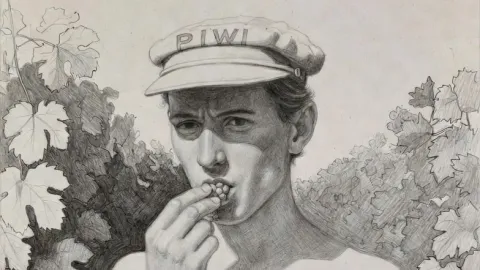
Seibel's true legacy was a genetic library. Almost every major French-American hybrid breeder who followed him built on his foundations. Bertille Seyve Sr. and Victor Villard worked from Seibel selections, producing varieties like Seyval Blanc (Seyve-Villard 5276) — a cross of Seibel 5656 and Rayon d'Or (Seibel 4986). While some have uncharitably suggested later hybridizers simply combined Seibel's grapes, breeders like the Seyve family utilized more complex selection programs. Today, Seibel’s work feeds into the modern PIWI movement — the German acronym for pilzwiderstandsfähig, or fungus-resistant — which has produced varieties like Regent and Solaris. As the wine world confronts climate change and pressure to reduce chemical inputs, the man once legislated out of the vineyard has become a foundational ancestor of the future.
How scholars have framed his work
The most substantial academic treatment of Seibel appears in Harry W. Paul's Science, Vine and Wine in Modern France. Paul examines the role of science in French viticulture from the phylloxera crisis onward, placing the hybrid movement within a larger narrative of the battle to reinvent the vine. He argues that while hybrids were a genuine scientific response to catastrophe, their wine quality fell short of the demands of the French establishment, leading to the victory of the grafted-Vitis vinifera system. Despite the lack of a standalone biography, Seibel’s work is extensively documented in French ampelographic sources, which remain the primary references for understanding his monumental contribution to the world of grapes.