Image
Country of origin
Germany
Variety number VIVC
25804
Prime name (VIVC)
Artaban
Year of crossing 1)
2000
Surface in (hectare) 1)
300
What is the origin?
Artaban is not a happy accident. There is no romantic origin story, no old vine discovered behind a shed in the Languedoc. It was designed by a committee — which sounds like a criticism but in this case is not, because the committee in question was INRAE Montpellier working with the Julius Kühn Institut in Siebeldingen, and the brief they gave themselves around the year 2000 was genuinely hard: build a red wine variety carrying multiple stacked resistance genes against both major fungal diseases, while keeping enough Vitis vinifera character to produce wine that someone would actually want to drink. Germany and Switzerland had been doing versions of this for decades. France arrived late and with a plan. The programme was called ResDur. Artaban, breeding number Montpellier 5-18-79, was registered in the French national catalogue in 2018, one of four ResDur varieties — alongside Floréal, Vidoc, and Voltis — that represented the first serious French bet on low-input viticulture's future.The parentage is worth understanding because it explains the resistance architecture. The mother is Regent — the German PIWI red that had demonstrated, more convincingly than anything before it, that a fungus-resistant variety could produce wine worth arguing about. The father is VRH 3082-1-42, a complex intergeneric hybrid assembled at Montpellier from Vitis vinifera varieties (Aubun, Cabernet Sauvignon, Garnacha Tinta, Merlot) crossed with Muscadinia rotundifolia, the Muscadine grape from the American southeast that is essentially immune to both mildews. The same cross also produced Vidoc — Artaban's sibling, darker and later-ripening, which tells you something about how much variation can come out of a single controlled parentage. Artaban's full genetic background spans Vitis lincecumii, Vitis rupestris, Vitis vinifera, and Vitis rotundifolia; some sources also list Vitis labrusca, though this is not consistent across the genetic literature. The exact proportions — how much is formally vinifera, how much is wild-species introgression — have never been published.
What made ResDur different was marker-assisted selection: tracking resistance loci in the DNA at every generation rather than waiting for a wet summer to reveal which seedlings had held up. In 2021 the CPVO recognised Artaban and its three siblings under the Vitis vinifera L. species designation for registration purposes — a regulatory decision rather than a botanical reclassification, since the non-vinifera ancestry is still in there, but it had the practical effect of opening the PDO pathway that had always been closed to interspecific hybrids. The name comes from a character in a series of historical romances — loyal, brave, resilient. Someone at INRAE thought about the branding. No synonyms are recognised in French or EU variety registers.
What is it resistant to?
The resistance profile is, on paper, exactly what you'd want. Against powdery mildew: Run1 from Muscadinia rotundifolia, which confers very high resistance to Erysiphe necator, plus Ren3 and Ren9, two partial-resistance loci inherited through Regent. Against downy mildew: Rpv1 from M. rotundifolia alongside Rpv3.1, a locus from North American Vitis species — though in a pedigree this complex, the exact donor lineage is messier than the gene name suggests. Two genes per disease, from independent sources, so that one breaking shouldn't take the other with it. The breeder's own guidance calls for two fungicide treatments per season as a baseline, with more under high pressure. Two instead of eight to twelve — a reduction that means everything to growers moving toward organic certification or trying to reduce copper use. Not zero. Anyone who implied otherwise wasn't reading carefully.The two-gene pyramid held through Artaban's first commercial seasons. Then 2024 arrived, and it was the season the programme had been quietly dreading. Exceptional pressure across France. Three Artaban vineyards in southeastern France, all within 40 kilometres of each other, developed severe downy mildew on leaves and clusters — not reduced severity, not partial symptoms, but full disease expression. Researchers took 21 Plasmopara viticola isolates from those sites and tested them. Nineteen of the 21 broke through Rpv3.1. Ten broke through Rpv1. Four distinct strains from two separate vineyards overcame the full Rpv1-Rpv3.1 pyramid simultaneously. The genetic analysis showed these strains had arisen independently — the pathogen had reached the same solution in multiple locations at once, driven by selection pressure strong enough to make convergent evolution the likely outcome rather than an anomaly. Published in Plant Disease, late 2025. The pyramided resistance had been overcome, and there is no version of that sentence that sounds good for Artaban.
Powdery mildew resistance appears to still be holding. But there is more to the disease picture, and this is where Artaban's promotional literature has always been selective: the official French ampelographic record lists the variety as sensitive to black rot and somewhat susceptible to grey rot. Black rot barely features in PIWI variety profiles because the mildew numbers are what everyone leads with, but it is a real disease in wet seasons and Artaban has a real sensitivity to it. No data exists on copper sensitivity, phytoplasma, or leafhopper behaviour.
How does it adapt to climate and what is its ripening profile?
Short version: Artaban ripens early, which is more of an asset in 2025 than it was in 2000.Phenological data from Domaine de Vassal puts bud burst at around four days after Chasselas — roughly 21 March under Mediterranean coastal conditions. Grape maturity arrives approximately one week after Chasselas, so early to mid-August at that site. In a Loire Valley or Burgundy running two weeks hotter than it was in 1990, an early-ripening red with solid colour, tannin, and decent acidity looks considerably more useful than it did when those regions were still wrestling with Pinot Noir ripening. That is not an argument for planting Artaban in Chambolle-Musigny. It is an argument for taking the variety's climatic range more seriously than the southern-France framing of the ResDur marketing tends to suggest.
One characteristic keeps appearing in every technical description, which means growers are actually running into it: the berries ripen early but the vine's vegetative growth shuts down late. Wood maturation lags behind the fruit. Young vines in particular show sensitivity to magnesium deficiency, which produces intense autumn leaf reddening and lignification problems. Beyond that, drought tolerance, frost hardiness, and formal heat-accumulation targets remain unpublished.
How does it grow in the vineyard?
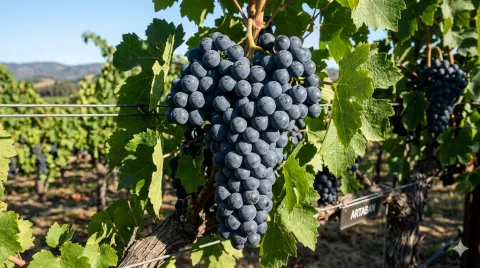
Moderate vigour, semi-erect growth. Not a vine that needs to be fought into submission — anyone who has managed a high-vigour PIWI will feel the difference immediately. Cluster architecture: large, conical, compact. Berries: small, thin-skinned, soft-pulped. Compact clusters and thin skins in a variety with a documented grey rot sensitivity is not a combination that should be buried in the footnotes, but in most Artaban literature it effectively is. The grey rot is in the official record. The black rot sensitivity is too. Together they describe a variety that genuinely reduces the mildew programme while still requiring serious disease management for two pathogens the marketing materials tend to wave past.Yield figures for commercial plantings have not been published in any accessible source — a notable gap for anyone trying to model the economics of adoption. Magnesium deficiency documented, especially in young vines. No rootstock recommendations in any published source. No soil preference data. No coulure or millerandage records. No training system preferences documented anywhere. One certified clone in France, number 1267, selected by INRAE Grand-Est Colmar.
How does the wine taste?
The official line from plantgrape.fr: light, well-coloured, fruity, for early consumption. Must weight average, acidity moderate, good balance. That is the floor. Comparative tastings put Artaban at the higher end of PIWI reds for colour intensity and tannin load, grouped with Vidoc, Merlot Khorus, and Monarch when phenolic contribution is the measure. The colour and tannins are real, which makes "for early consumption" feel like it's underselling something. One source puts cellaring potential at five to seven years depending on the producer — no ageing study backs that up but it is not an implausible claim given the structure. Hard analytical data — Brix ranges, pH, titratable acidity, anthocyanin concentrations — has not been published in any standardised comparative form, which is worth flagging for anyone expecting numbers.Rosé works. Pale pink to salmon, strawberry and redcurrant, clean finish — consistent across everything available. In blending trials measuring how much Artaban a Merlot can absorb before consumers push back, the structural contribution in colour, acidity, and tannin was found to be significant. The variety has a real role in blending rooms across the south of France, where thin-skinned conventional reds are increasingly the problem and Artaban is one answer. It is still more a component than a headliner. Whether it ever becomes the variety on the front of the bottle rather than the thing quietly holding the blend together is, at this point, a marketing question more than an agricultural one.
What is the distribution, regulatory status and market development?
French A-list variety since 2018. Recognised under Vitis vinifera L. by the CPVO for registration purposes in 2021. Approved for PGI Pays d'Hérault since 2023. First documented commercial planting was 1.35 hectares in 2016, with a first harvest in September 2018 yielding around 5,000 bottles — commercial-scale production took longer as vines reached proper maturity in the early 2020s. Between 2017 and 2021, 153 hectares were planted in France, more than any other PIWI red in that period, with Vidoc second at 112. Publicly confirmed data beyond 2021 doesn't exist, but the direction was consistently up.The regulatory picture is more advanced than a flat "not yet in the AOC system" would suggest. Under France's VIFA framework — Variétés d'Intérêt à Fin d'Adaptation — some regional appellations have begun incorporating resistant varieties including Artaban as accessory blend components, typically at a small percentage cap. Not a named-variety AOC right, but a foot in the door. Getting further runs into something no regulation dissolves on its own: French appellation culture's deep suspicion of anything that looks like a hybrid, which survives CPVO reclassifications and ministerial circulars and will probably outlast a few more of them yet. Commercial planting is legal everywhere. Named-variety PDO wine from Artaban remains a future prospect. Outside France, no confirmed commercial-scale plantings appear in public registers, though small-scale and experimental adoption in neighbouring countries is probable.
Number of nurseries
10
Number of estates
10
Total number of wines offered by estates
13
Which estates and wines stand out?
Nothing. No estate with international standing has staked its identity on Artaban. No major award for a varietal bottling in any vintage on record. The variety is in the ground across well over a hundred hectares and the wine is being made — somewhere, someone is probably doing something serious with it quietly — but nobody has yet done what Mas de Daumas Gassac did for Cabernet in the Languedoc, which is use the variety to build a reputation rather than just fill a gap. Within resistance-breeding circles Artaban matters, as one of the first fully MAS-selected PIWI reds to reach commercial scale in France. Outside those circles, not yet.What is the future outlook?
Planted area will keep rising. Spray costs, tightening pesticide regulations, European sustainability targets, the appetite for organic certification — all of it pushes growers toward resistant varieties, and Artaban is the most familiar red option with real traction in the French market. The early-ripening profile extends its range northward as the climate shifts. None of these forces are reversing.But 2024 left a mark. Artaban was among the first ResDur varieties to have its downy mildew pyramid broken in the field under documented conditions — broken by several strains, independently. INRAE has already moved on: ResDur3 adds Rpv10 to the stack, and recent data shows the three-gene pyramid holding well under the same pressure that exposed Artaban's limits. The programme answered the question. The answer came one generation after it was needed.
AOC recognition will arrive eventually, and when it does it will bring planting demand and consumer visibility and the kind of momentum that turns a functional variety into a named wine. Worth waiting for. But it will not change the resistance arithmetic. The next bad summer is coming — it always is — and when it arrives, Artaban growers will be managing with the knowledge that the pyramid held until it didn't, and that the generation built to replace it is already in the nursery.