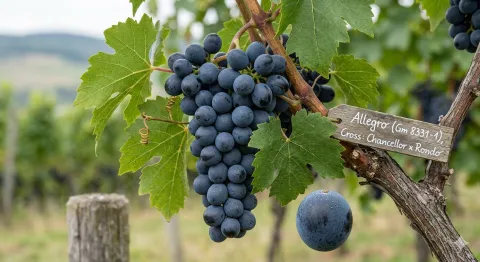
What is the origin?
Geisenheim made Accent in 1982 and Allegro in 1983. Same breeder, same building in the Rheingau, same Chancellor parent. Whether that reflects systematic thinking — exhaust every useful combination from a proven resistance vehicle — or simply the rhythm of a busy breeding programme is impossible to say from outside. Allegro exists because someone put Chancellor with Rondo rather than with Kolor, and that second choice is everything.
Rondo is interesting in its own right. Professor Vilém Kraus created it in Czechoslovakia in 1964, crossing Zarya Severa — a Russian hybrid with Vitis amurensis in its background, bred for frost tolerance in the Amur River region — with St. Laurent. Kraus offered the material to Helmut Becker at Geisenheim, who took up the selection and testing work. The Geisenheim number, Gm 6494-5, marks where the development happened rather than where the original cross was made. Becker ran the institute’s breeding programme until his death in 1990. He crossed Chancellor with Rondo in 1983 and never saw what came of it.
The species inventory that results from those two parents covers Vitis vinifera, Vitis amurensis, Vitis labrusca, Vitis lincecumii, and Vitis rupestris — the last four carried through Albert Seibel’s early twentieth-century hybridisation work on the Chancellor side, and the amurensis through Zarya Severa via Rondo. Both wein.plus and reben24.de add Vitis aestivalis to this inventory. The problem is that Chancellor’s confirmed species list does not include aestivalis — it carries lincecumii — and nothing in Rondo’s lineage introduces it either. No source explains where the attribution comes from, and no primary genetic study has confirmed it. Both catalogues state it as fact. They may both be wrong, or the attribution may trace back to a Seibel sub-pedigree nobody has published in accessible form. Chancellor is itself registered in the VIVC under its breeder designation Seibel 7053, and its genealogy is sufficiently layered that some uncertainty at the edges is not surprising.
What the VIVC records for Allegro: breeding number GM 8331-1, synonyms Geisenheim 8331-1 and GM 8331-1, SSR marker confirmation not recorded, resistance loci — none. Accent, crossed the previous year from the same Chancellor parent, at least has Ren3 and Ren9 on record. On dates: the VIVC records plant variety protection in 2006; a German nursery catalogue gives 2002 for Sortenschutz and 2009 for the Sortenliste entry; wein.plus puts both in 2009. The 2009 date for the German variety list is where all sources converge. The EU Common Catalogue registration is confirmed.
How does it adapt to climate and what is its ripening profile?
The ripening question is genuinely unresolved and nobody seems bothered by that. Wein.plus says medium. Reben24.de, citing Geisenheim’s own description, says late. A retail source says early to medium-early, which contradicts both. Late has the stronger case on the logic of the parentage, but no trial compares Allegro against a reference variety with actual calendar dates attached. For a grower deciding whether their site is suitable, the difference between medium and late is not an abstraction — it is the difference between a workable harvest and a gamble. Qualitative bud break descriptions from nursery sources suggest medium to late, which at least implies some natural spring frost protection from delayed shoot emergence, but that is about as far as the public record goes. No degree-based frost hardiness rating, no Huglin or Winkler thresholds, no drought response data. The Vitis amurensis inheritance through Zarya Severa is clearly doing something for winter hardiness — that rating is very good in every source — and as northern European growing regions warm, exactly how much frost tolerance a red wine variety actually needs will keep shifting. At some point extreme cold hardiness becomes a lesser selling point, which is relevant to how long Allegro’s most distinctive inherited trait retains any value.
How does it grow in the vineyard?
The cluster is loose-berried, medium-sized, blue-black. Vigour is robust. Yields are described as stable, though stable against what benchmark, in which conditions, at what vine density, over how many seasons — none of that is specified anywhere. Must acidity is medium. At least one German nursery offers it on SO4, 5BB, and 125AA, which are standard rootstocks for German red varieties rather than anything specific to Allegro’s soil preferences or vigour management requirements. No pruning system is documented. Nobody has published anything on coulure, millerandage, or mechanical harvesting suitability. These gaps exist because Allegro has not been planted in commercial numbers that would generate the trial data to fill them. That is the summary of this section, really.
How does the wine taste?
The wines are intensely ruby-coloured, which every source agrees on, and after that they all reach for the same handful of words: ripe red forest fruits, spice notes, mild tannins, medium acidity. The uniformity is suspicious — it suggests a single Geisenheim variety description being restated through multiple channels rather than independent tasting experience. What the variety actually does in glass, at different stages of maturation, from different terroirs, under different winemaking hands, is simply not documented. One German resistance breeding overview places Allegro in a third generation of PIWI reds that no longer taste distinctly non-European — alongside Johanniter, Bolero, Regent, Cabernet Cortis — which at minimum means the variety crossed a sensory threshold that the first-generation hybrids, whose growers were paid compensation to pull them out of French vineyards, never came close to.
Whether the mild tannins have any development potential, whether the fruity profile holds up with age or collapses into jam, whether the medium acidity gives the wine enough structure to do anything interesting in a blend — no ageing trials, no must analysis, no comparative vinification data exists. The nursery says it cellars well. That is a sales claim, not evidence.
What is the distribution, regulatory status and market development?
Germany’s national variety list: 2009. EU Common Catalogue: confirmed. Planted area in regional German wine statistics: not recorded. That last fact almost certainly reflects the absence of commercial-scale planting rather than the absolute absence of the variety — trial plots and nursery blocks rarely appear in official statistics — but confirmed plantings anywhere cannot be identified. Switzerland and Austria, both relevant for frost-tolerant PIWI varieties, could not be confirmed from publicly accessible sources.
The most pointed observation about Allegro’s commercial situation is not the missing statistics. It is Rondo. Allegro’s own parent is planted across England, Ireland, Denmark, and the Netherlands because of precisely the traits it passed to Allegro — frost tolerance, disease resistance, accessible red wine style. Growers in those countries choose Rondo. They do not choose Allegro, despite the shared inheritance. Whether this reflects ignorance of the variety, considered preference for the parent, or simply that Allegro has never been marketed in those markets is not something the data can settle. Whether Allegro qualifies for quality wine designation under the Landesrecht conditions of specific German regions — the gate that silently blocks many listed PIWI varieties from label eligibility — has not been publicly tested by any producer.
Which estates and wines stand out?
There isn’t one.
What is the future outlook?
Allegro’s problem in 2026 is not a single failure. It is an accumulation of smaller ones. The frost tolerance is real but Rondo already covers that ground. The accessible fruity style is real but Cabernet Cortis, Cabernet Cantor, Prior, and Cabertin offer comparable versions with documented resistance loci and existing commercial relationships behind them. The Chancellor-based resistance architecture has no published loci mapping and therefore no credibility with the growers and certifiers who now ask for that documentation as a matter of course. There is no flagship wine, no advocate estate, no critical reputation, no planted area that registers in any statistic. And the warming of northern European growing regions means that extreme frost hardiness — the one inherited advantage Rondo does not make redundant — may matter less to growers in twenty years than it does today.
Geisenheim made the cross in 1983. Becker never saw it registered. The variety spent twenty-six years reaching the variety list and has now spent another sixteen on that list without leaving a trace in any commercial record. What would have to change for any of that to shift is not visible from here.