Image
Country of origin
Hungary
Prime name (VIVC)
Aletta
Cultivar name
Aletta
Year of crossing 1)
1975
Surface in hectares
1300
What is the origin?
You will not find a romantic origin story here. No ancient monastery, no eccentric aristocrat, no happy accident in a neglected corner of a famous vineyard. What you get instead is a research station in Eger, methodical breeders — primarily Csizmazia and Bereznai, with Pál Kozma credited in some official records — and a programme that had one clear goal: build a white grape that survives Hungarian winters without falling apart.Their earlier varieties had already proved the concept. Zala Gyöngye was recognised in 1970, Bianca in 1982, Medina in 1984. Aletta followed later in that sequence, the same logic applied to a slightly different problem: aromatic character alongside the cold-hardiness that Bianca never quite delivered.
The parentage is Muscat Ottonel × Eger 2, which sounds simple until you look at Eger 2. For years it was classified as an open-pollinated seedling of Villard Blanc — the French hybrid Seyve-Villard 12-375, bred at the Seyve-Villard establishment in Saint-Vallier, Drôme, using Albert Seibel's foundational lines. DNA profiling confirmed it: Eger 2 is the same thing as Villard Blanc, whatever the historical paperwork called it. Not every source treats the question as fully closed, but the practical consensus has moved on.
The same variety, selected in Eger, given a Hungarian number, then used as a crossing partner across multiple new cultivars including Aletta. Through that lineage, Aletta carries Vitis berlandieri, Vitis rupestris, and Vitis vinifera bloodlines — the resistance from the American side, the aroma from Muscat Ottonel. Classical crossing throughout. Marker-assisted selection did not exist in Hungarian viticulture at the time.
The variety was on the Hungarian registered list from 2003, six years before plant breeders' rights were formally granted in 2009. It is catalogued in the EU Common Catalogue under VIVC 23102. The breeder designation is EC.18, an Eger code, which some sources render as ECS 18. The synonym Egri Csillagok 18 also circulates, but Egri Csillagok is separately a protected designation of origin for a white Eger blend and the two should not be confused. Where the name Aletta comes from: Hungarian sources point to Aletta van der Maet as the inspiration, a small literary gesture inside an otherwise entirely practical project.
What is it resistant to?
Here is what Aletta was actually built for. The variety resists powdery mildew, downy mildew, and grey rot — inheriting that profile directly from the Villard Blanc side. That is resistance, not immunity; how well it holds in any given year depends on site, season, and what the local disease pressure looks like. But in the field it translates to firm-skinned, loose-clustered berries that simply do not rot the way Muscat Ottonel does. A 2014 economic study in the journal Gradus put numbers to it: comparing Aletta and Muscat Ottonel on a lowland farm in Soltvadkert, plant protection costs were the single biggest financial difference between the two varieties, with Aletta requiring far fewer interventions across the season.What the literature does not give you — and this is a real gap — is any formally documented resistance loci. No Rpv, no Ren, nothing in the VIVC entry under genetics. Aletta was bred before that kind of characterisation was standard practice, and the same is true of most varieties from that generation — a documentation problem baked into an entire era of breeding work, not something specific to Aletta.
There is more recent genomic work on Villard Blanc descendants suggesting that Aletta probably carries the Rpv3.1 locus for downy mildew resistance and Ren3 loci for powdery mildew resistance. Nobody has published that as a specific finding on Aletta. For growers who have planted it, the field performance speaks clearly enough. For breeders considering it as crossing material, not having a genetic map is a genuine problem.
Then there is the frost. Rated to around –22°C, with reports of survival through the winters of 1984–85 and 1986–87 when temperatures in the lowland reportedly dropped well beyond that — exact figures that circulate in secondary sources without being verified against anything more primary than another secondary source. Those two winters broke Muscat Ottonel parcels across the Hungarian lowland. Aletta vineyards kept producing.
Even after partial frost damage, the variety can recover close to a full crop from its secondary buds — something conventional varieties cannot do. That is not a fungal-resistance locus. It cannot be sequenced or marketed. But in the Kunság and the Great Plain, where a single killing frost can wipe out a year's income, it is worth more than almost anything else a variety can offer.
How does it adapt to climate and what is its ripening profile?
Aletta is a continental interior grape. It was designed for Hungarian lowland conditions — hot summers, cold winters, flat sandy terrain, and a frost calendar that makes maritime varieties look naive. The formal label is continental Pannonian Basin viticulture. The variety was built for it and nothing else. The same Gradus 2014 analysis made the economic case bluntly: over ten years, the statistical likelihood of at least one complete frost-kill destroying a Muscat Ottonel harvest made that variety unprofitable for lowland growers. Aletta survived every winter in the trial without a total loss.Harvest comes in the first half of September in the lowland, though the timing moves around across the other Hungarian wine regions where the variety appears. Must sugar sits at 18–20 degrees Mustometer with acidity running 6–8 g/l, expressed as tartaric equivalent — ripe but not overripe, aromatic but not particularly tense. No Huglin index, no drought tolerance data has been published for this variety. The climate data that exists is practical and farm-level rather than scientific. Which tells you something about where Aletta sits in the research priorities of Hungarian viticulture.
How does it grow in the vineyard?
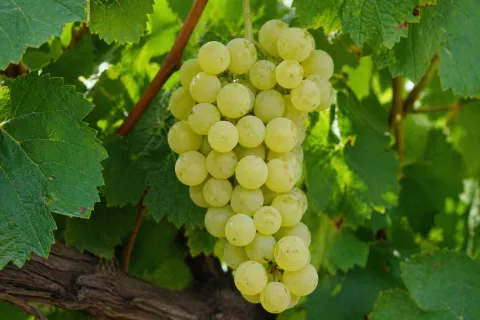
Strong grower. The vine throws vigorous lateral shoots through summer and the canopy will close on you if you let it, which creates shade problems and invites the botrytis that Aletta is supposed to resist. It rewards leaf management. Ignore it in July and you have undone the variety's best quality with your own negligence. The vines are otherwise undemanding — not fussy about soil, indifferent to aspect, planted on sand and loam alike across the lowland without meaningful distinction.Clusters run small to medium, between 130 and 210 grams depending on conditions, winged or shouldered in shape, and usefully loose. Berries are small (around 1.7g), round, yellowish-green, heavily bloomed, with firm skins and muscat flavour even before full sugar ripeness. Yield averages 15 to 18 tonnes per hectare of fruit weight — genuinely high. The Gradus comparative study found Aletta's yield running nearly double that of Bianca under the same conditions, driven by better bud fertility and heavier bunches. Those are trial results from specific sites; your own ground may tell a different story.
The economic analysis puts this in perspective: over a ten-year horizon, Aletta was dramatically more profitable than Muscat Ottonel on comparable lowland sites in the farm model studied. The number comes out of specific frost-risk assumptions and a particular vineyard setup — not a universal law, but the basic logic is hard to argue with. Not because the wine commands a premium — it does not — but because the vine keeps producing when Muscat Ottonel has frozen to death.
High-cordon and Moser-cordon training dominate in the regions where Aletta is grown, and the vine is suited to mechanical harvesting. No rootstock recommendations appear anywhere in the literature. Nobody has published a detailed soil preference study. There is a whole tier of basic technical documentation that simply does not exist for Aletta, and the reason is the same every time: the variety has never generated enough commercial interest to push for it.
How does the wine taste?
Muscat. That is where this begins and largely where it ends. The wine is white, aromatic, soft-acids, full-bodied by lowland standards, and alcohol-rich at the must sugars Aletta typically reaches. When harvested on time it is genuinely pleasant — fragrant, slightly round, unchallenging. The acidity at 6–8 g/l — tartaric equivalent, for anyone comparing across sources — is moderate and tends soft, which keeps the wine easy but limits its ambition. Hungarian academic sources describe it as an excellent blending component and a sound vehicle for aromatic bulk white wine. Nobody describes it as complex.Ageing potential: unknown, unaddressed, probably not the point. Sparkling base potential: not evaluated. Vinification constraints: not published. What appears in the literature is the verdict of the bulk market — early consumption, mixed-white blends, table wine. Whether something more interesting lives inside this variety waiting for a grower willing to cut yields and think carefully in the cellar — that question has simply not been asked yet.
What is the distribution, regulatory status and market development?
Legally clear, commercially invisible. Aletta is in the EU Common Catalogue. National qualification in Hungary: 2009, with a registration step already completed in 2003. One of a large number of white varieties authorised for cultivation across the country. Commercially planted and sold across the Kunság, Csongrád, and Hajós-Baja regions, with meaningful presence also in Etyek-Budai, Balaton-Felvidéki, and Balaton-Melléki. The Hungarian statistical office confirms it alongside Bianca as one of the most widely planted resistant varieties in the country.On planted area: the sources do not fully agree. One dataset puts the figure at around 423 hectares in 2012. A 2014 Gradus paper has it at 1,300 by 2013. Wein.plus, citing Kym Anderson's statistics, gives 1,676 hectares for 2016 with a strong upward trend. The growth trajectory is real; the exact numbers depend on who counted, when, and how. A figure of 13,000 hectares appeared in one companion paper from 2014 — almost every other data point makes it impossible. The 1,300 from the same research group's second paper is the figure that survives scrutiny.
Outside Hungary, propagation material has attracted some international interest, and limited plantings have been reported in Russia — where the frost argument travels well — along with smaller experimental adoption in Romania and parts of Germany. No substantial confirmed foreign plantings appear on any widely reviewed registry. The PDO question — whether Aletta can appear on a premium label — has not been addressed. The variety is legally authorised for quality wine production; it has been since 2009. It is not prohibited. It is ignored, which in practice amounts to the same thing.
Number of nurseries
9
Number of estates
5
Total number of wines offered by estates
5
Which estates and wines stand out?
Nothing to report. No internationally recognised estate has committed to Aletta as a flagship variety. No major wine competition has put a varietal Aletta bottling on its podium in any year on record. No high-profile restaurant list carries it. What exists is a large planted area producing wine that flows quietly into blends and bulk categories, doing its job without a name on the front of a bottle. That is not nothing — but it is not a reputation either.What is the future outlook?
The case for Aletta in the next decade runs like this: warming springs reduce late-frost risk across Central Europe, which should in principle help late-budding varieties. Aletta buds late, which has always protected it against spring frost, and that advantage may matter more as seasons shift unpredictably. In lowland Hungary, where the worst frost years have historically destroyed harvests entirely, a variety with hardiness rated to around –22°C and strong secondary-bud recovery still has a strong practical argument even if winters trend milder on average. The case against is louder. Climate change is not just warming winters — it is pushing sugar accumulation faster through hotter summers, which will deepen Aletta's already-soft acid problem and require earlier harvest to avoid flabby, unstructured wine. And the PIWI market is moving in a direction that leaves Aletta behind regardless of climate: toward varieties with documented resistance loci, international branding, and premium positioning.Souvignier Gris, Muscaris, Cabernet Blanc — these are the varieties generating excitement and research investment. Aletta has no resistance map, no international name, no critical champions, and no pathway out of the bulk tier that its entire history has prepared it for. Over 1,600 hectares planted and the variety is still, essentially, anonymous. That does not change unless someone decides to change it. So far, no one has.